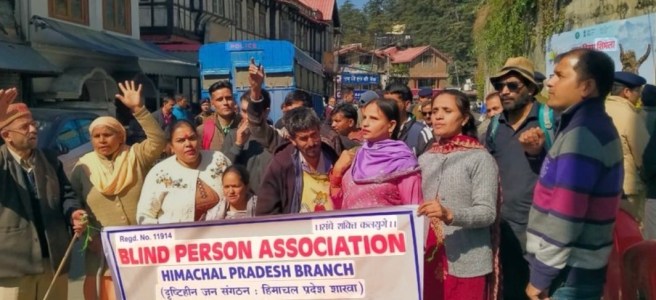
Nearly three years of protest, repeated demands over reserved vacancies, an unfinished disability-rights framework, and now a clear judicial direction: take effective steps to fill vacant Class-IV posts for visually impaired persons and issue the necessary advertisement.
Continue reading “From Protest to Recruitment: How Himachal’s Blind Community Took the Disability Rights Gap to the High Court”Category: Activism
Internet Shutdowns and Fundamental Rights: The Test Under Articles 19 and 21
An internet shutdown is often described as a temporary step taken to control a difficult situation. For the person unable to make a payment, attend a class, contact a hospital, report the news or access a court website, however, the shutdown is anything but abstract. It is the law entering everyday life through a blank screen.
Continue reading “Internet Shutdowns and Fundamental Rights: The Test Under Articles 19 and 21”Posted in a Hard Area, Working in Shimla: Himachal High Court Closes the Record-Keeping Gap
An employee may be posted on paper at a tribal or difficult station but actually work at a more convenient location. Until now, an incomplete service record could allow the employee to continue receiving the administrative benefit of the hard-area posting. The Himachal Pradesh High Court has directed the State to close that gap.
Continue reading “Posted in a Hard Area, Working in Shimla: Himachal High Court Closes the Record-Keeping Gap”When a PIL Conceals a Private Contest: Himachal High Court’s ₹2 Lakh Warning
Public-interest litigation relaxes the traditional rules of standing, but it also places an unusually high burden of candour on the person invoking it. In Ajay Bhaik v. State of Himachal Pradesh, the Himachal Pradesh High Court found that this burden had not been met—and forfeited the petitioner’s deposit of ₹2 lakh.
Continue reading “When a PIL Conceals a Private Contest: Himachal High Court’s ₹2 Lakh Warning”High Court Cracks Down on Unscientific Desilting at Barot–Shanan Project; Imposes Safeguards to Protect Trout Habitat
Shimla, April 8, 2026
In a significant environmental ruling, the High Court of Himachal Pradesh has issued stringent directions regulating desilting operations at the Shanan Hydroelectric Project in Barot, holding that unscientific discharge of silt into the Uhl River has caused serious ecological damage, including fish mortality and degradation of a nationally important trout habitat.
Continue reading “High Court Cracks Down on Unscientific Desilting at Barot–Shanan Project; Imposes Safeguards to Protect Trout Habitat”Straying from the Law to Cage Compassion – Supreme Court’s diktat on street dogs of national capital
When the Supreme Court’s August 2025 order on street dogs dropped, it landed with all the subtlety of a bulldozer in a butterfly garden. In one sweep, the Bench declared that every single community dog in Delhi-NCR must be rounded up, carted off to shelters, and never set paw on its old street again dismissing, without ceremony, any voice of dissent from animal welfare groups. The problem? India already has a law for this, the Prevention of Cruelty to Animals Act and the Animal Birth Control Rules, 2023 and that law says precisely the opposite: sterilise, vaccinate, and return them to their home turf, not exile them indefinitely. In the courtroom drama of “public safety versus compassion,” the scriptwriter here seems to have thrown the statute book out of the window.
Continue reading “Straying from the Law to Cage Compassion – Supreme Court’s diktat on street dogs of national capital”The Advocates (Amendment) Bill, 2025: A Threat to Judicial Independence and the Sanctity of the Legal Profession
“The legal profession is not merely an occupation; it is the guardian of justice, the voice of the oppressed, and the first line of defense against tyranny. An independent Bar is the cornerstone of an independent judiciary—compromise it, and you compromise the very foundation of democracy.”
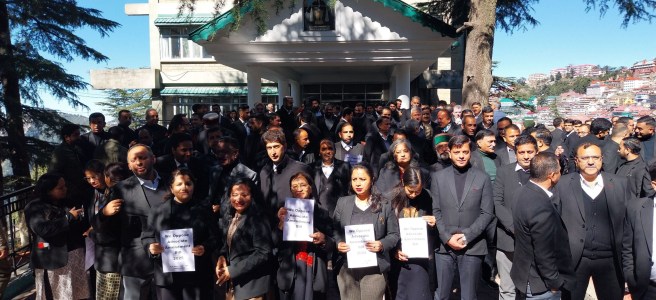
If the Advocates (Amendment) Bill, 2025 had a motto, it would be: “Speak less, comply more, and never question authority.” Wrapped in the language of “reform,” this Bill is less about improving the legal profession and more about taming it. It reads like a playbook for turning fierce, independent advocates into government-approved legal service providers, carefully selected to avoid ruffling any executive feathers. By expanding control over the Bar, criminalizing dissent, and creating a chilling effect on legal activism, the Bill seems designed to ensure that lawyers think twice before taking up cases that challenge the powers that be. In a democracy, advocates are meant to be the watchdogs of justice—but with these amendments, the government appears keen to turn them into obedient house pets, barking only when permitted. The message is clear: fall in line, or risk professional extinction. But history has shown that the legal fraternity does not take kindly to such attempts at subjugation—and the overwhelming resistance to this Bill proves that the fight for an independent Bar is far from over.
Continue reading “The Advocates (Amendment) Bill, 2025: A Threat to Judicial Independence and the Sanctity of the Legal Profession”High Court seeks Rigorous Compliance of sanitation issues: Respect for shared spaces and lessons from Japan
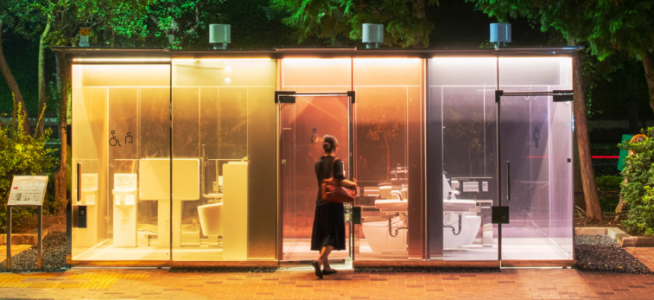
The scene portrayed above is from a Japanese movie, Perfect Days (2023), directed by Wim Wenders. The film portrays the life of a Tokyo toilet cleaner, Hirayama, who finds profound meaning and dignity in his seemingly mundane job. The philosophy of Perfect Days emphasizes finding dignity, meaning, and beauty in tasks, like cleaning toilets, reflecting the profound connection between care for shared spaces and human respect. As essential public services, sanitation and toilets embody this philosophy by upholding public health, equality, and dignity for all. Together, they remind us that even the simplest actions in maintaining hygiene can have transformative societal impacts.
The High Court’s various directives in CWPIL 6 of 2017 and the philosophy of Perfect Days converge on a universal truth: dignity resides in the care we show for our shared spaces and responsibilities. Just as Hirayama’s work elevates public toilets to sanctuaries of care, the court’s insistence on accountability and sustainable practices transforms sanitation into a symbol of collective respect and progress.
Inconvienient Judgments that ruffle too many feathers-The case of the silent majority, Judicial Transfers and Sherlock Holmes
Imagine Sherlock Holmes sitting in his Baker Street flat, scratching his head over the enigma of judicial transfers in India. “It’s quite elementary, my dear Watson,” he might say, “except when it’s not. The transfers happen without consent, reasons are shrouded in secrecy, and the silent majority watches as the plot thickens!”
Continue reading “Inconvienient Judgments that ruffle too many feathers-The case of the silent majority, Judicial Transfers and Sherlock Holmes”Buy-back policy, HIPA Training, Special Task Force, and other directions by the High Court to Combat Solid Waste Issue
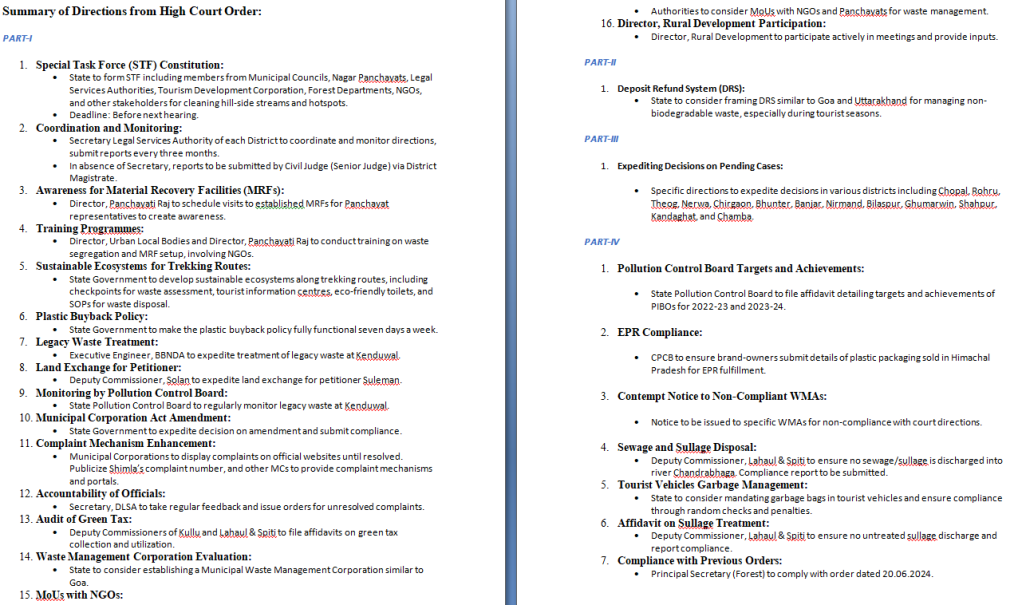
Shimla, August 8, 2024 – The division bench of the High Court of Himachal Pradesh presided over by J. Tarlok Singh Chauhan and J. Sushil Kukreja, in its ongoing commitment to environmental preservation, has issued a series of significant directives aimed at enhancing solid waste management across the state. Building on its earlier orders on March 23, May 9, 2024 and July 18, 2024., the court has now introduced new measures to ensure that these efforts reach the most critical areas and involve every level of society. The court’s new order, dated August 8, 2024, builds on these earlier measures with additional, targeted directives. Let’s dive right in:
Continue reading “Buy-back policy, HIPA Training, Special Task Force, and other directions by the High Court to Combat Solid Waste Issue”High Court Issues Comprehensive Directives to Tackle Solid/Plastic Waste Issue in Himachal Pradesh
Shimla, July 24, 2024 – In a landmark ruling on July 18, 2024, the High Court of Himachal Pradesh, under the astute guidance of Judges J. Tarlok Singh Chauhan and J. Sushil Kukreja, issued an exhaustive order that promises a greener future. This pivotal decision, following the court’s March 23 and May 9, 2024 Orders, addresses critical aspects of compliance and sets forth robust directives for solid waste management. Lets dive right in:

The Proposal to Charge Electricity and Water at Commercial Rates for Homestays: A Critical Examination
In a surprising and controversial move, the Himachal Pradesh government recently announced a proposal to impose commercial rates for electricity and water on homestays. This decision was revealed in various news outlets indicating that a proposal to provide electricity and water facilities in the state’s homestays at commercial rates has been placed before the Cabinet Sub-Committee constituted to amend the Home Stay Rules 2024.
For years, homestays have been a lifeline for middle-class and lower-income families, providing a vital source of supplementary income and contributing to the local economy. However, this new policy threatens to undermine the very foundation of homestays, turning what was once an accessible and inclusive form of tourism into a financially burdensome endeavour. The government argues that aligning utility rates with commercial standards is necessary for regulatory consistency and financial sustainability. However, this rationale fails to consider the unique nature of homestays, which operate on a small scale and offer tourists an authentic, home-like experience rather than a commercial service. The proposal raises critical questions about economic inequality, property rights, and the future of sustainable tourism in Himachal Pradesh. In this blog, we will delve into the multifaceted implications of this proposal, examining how it stands to impact local livelihoods, exacerbate economic disparities, and contradict the very principles of the Incredible India scheme.
Continue reading “The Proposal to Charge Electricity and Water at Commercial Rates for Homestays: A Critical Examination”