
Himachal Law Journal: Admissions, Service Rights, Local Governance and Public Law

Himachal Law Journal masthead beside the snow-covered Tudor-style Himachal Pradesh High Court building.

The law can be exacting about deadlines without being blind to why they were missed. A disputed counselling payment put an MBBS seat in jeopardy. A daughter-in-law’s electoral eligibility turned on the reach of a panchayat disqualification. Transport enforcement raised the question whether the same rules apply to private and State buses. Service disputes tested suspension, military-service benefits and seniority against their governing instructions. Beyond the courtroom, green-belt restrictions and inspections of sewage-treatment facilities brought environmental compliance into sharper focus. Across admissions, elections and administration, the common question is not whether rules matter, but whether they are being applied lawfully and fairly.

Continue reading “Himachal Law Journal: Admissions, Service Rights, Local Governance and Public Law” →
Himachal Law Journal: Service Rights, Criminal Justice, Ecology and Supreme Court Developments

Himachal Law Journal masthead beside the snow-covered Tudor-style Himachal Pradesh High Court building.

An insurer cannot be made to pay for a risk its operative policy did not cover, but neither can a prolonged undertrial detention be dismissed as an unfortunate consequence of a defective investigation. Between those poles, the Himachal High Court examined service claims, pension options and transfers. The Supreme Court considered compensation for failures in criminal investigation and the reach of information law. Ecological scrutiny returned to the Himalayas when the Court sought the State’s response to an expert report, while other decisions probed electricity disconnection, bail, tax reassessment and property rights. The thread running through these disputes is a deceptively ordinary question: what does the law actually authorise, and what follows when that authority is exceeded?

Continue reading “Himachal Law Journal: Service Rights, Criminal Justice, Ecology and Supreme Court Developments” →

Himachal Law Journal: Maternity Rights, Pension, Criminal Procedure and Environment

Himachal Law Journal masthead beside the snow-covered Tudor-style Himachal Pradesh High Court building.

A tax notice cannot draw authority from a rule that has already been omitted, and the rights of a commissioning mother raise questions that cannot be answered by administrative labels alone. The Himachal High Court also examined pension eligibility, criminal appellate procedure and the treatment of litigants with disabilities. In education, it considered what school consolidation must mean for students’ basic sanitation needs. A dispute over retained stridhan called for attention to the nature of the alleged offence and the applicable law. Beyond Himachal, the Supreme Court turned to the protection of wetlands. Different disputes, certainly, but each asks whether legal safeguards survive contact with administrative practice.

Continue reading “Himachal Law Journal: Maternity Rights, Pension, Criminal Procedure and Environment” →

Himachal Law Journal: Seniority, Arbitration, Pensions and Public Law

Himachal Law Journal masthead beside the snow-covered Tudor-style Himachal Pradesh High Court building.

Does a place on a selection list make someone senior before they join? Can an employer disregard an unstayed reinstatement award? And when road or high-rise projects advance, what happens to the environmental safeguards meant to govern them? The Himachal High Court considered these questions alongside family-pension claims, arbitration enforcement and restrictions on land use. The Supreme Court’s decisions on arbitration seats, professional-course fees and insolvency deadlines widened the discussion: discretion has limits, and procedural shortcuts cannot substitute for lawful authority. This edition follows those limits from the service register to the construction site and the courtroom.

Continue reading “Himachal Law Journal: Seniority, Arbitration, Pensions and Public Law” →

Himachal Law Journal: Service Rights, Criminal Justice and Environment

Himachal Law Journal masthead beside the snow-covered Tudor-style Himachal Pradesh High Court building.

A selected Medical Officer does not become a trainee merely because the employer changes the description of the appointment. Admitted leave encashment cannot simply be withheld for want of funds, and a recruitment condition cannot be rewritten as an equivalence the rules never recognised. This edition tests public employers on their duties, criminal courts on the evidentiary record, and regulators on the scientific basis for anti-hail guns and the control of muck dumping. National decisions add questions about election procedure, pharmaceutical marketing and insolvency. Behind that range lies one recurring concern: institutions must administer the law as it stands, rather than reshape it for convenience.

Continue reading “Himachal Law Journal: Service Rights, Criminal Justice and Environment” →

Himachal Law Journal: Succession, Service Law, Arbitration and SARFAESI

Himachal Law Journal masthead beside the snow-covered Tudor-style Himachal Pradesh High Court building.

A will may fail because its intended beneficiary died first. A land-acquisition notice may lose force because the statutory clock has run out. Elsewhere, a frozen bank account, a dismantled water channel and a secured-asset auction required courts to distinguish the remedies a statute permits from those it does not. The Himachal High Court also considered parole, service pay and pension recovery, while environmental proceedings reached trekking safeguards and allegations concerning Sambhar Lake. These decisions are connected less by subject than by a judicial discipline: the effect of an order, a right or a remedy depends on the particular legal conditions that govern it.

Continue reading “Himachal Law Journal: Succession, Service Law, Arbitration and SARFAESI” →

Himachal Law Journal: Service Law, Arbitration, Criminal Justice and Public Interest

Himachal Law Journal masthead beside the snow-covered Tudor-style Himachal Pradesh High Court building.

A signed blank cheque may still attract a statutory presumption, but doubtful identification cannot sustain a criminal conviction by repetition alone. The same need for legal precision runs through pension commutation, delayed promotion, contract service and the consequences of an operative conviction. On the civil side, the Himachal High Court examined revenue records and recoveries following a re-auction. Nationally, arbitration interest, investigation deadlines and insurance liability received close scrutiny. These cases turn on distinctions that may seem small until they decide an outcome: between a presumption and proof, between an earned benefit and an assumed entitlement, and between a statutory power and its limits.

Continue reading “Himachal Law Journal: Service Law, Arbitration, Criminal Justice and Public Interest” →

Himachal Law Journal: Service Rights, Pension and Civil Procedure

Himachal Law Journal masthead beside the snow-covered Tudor-style Himachal Pradesh High Court building.

How many years of service does a rule see? The Himachal High Court considered whether years spent on contract count after regularisation, whether maternity leave interrupts qualifying service, and whether a retiring employee may still claim an increment. The answers emerge not from labels but from the rules that give those years legal significance. Other cases ask whether an acquittal displaces disciplinary findings, when pleadings may be amended after trial begins, and how recruitment eligibility and criminal evidence must be assessed. From the service book to the witness box, this edition examines the difference between a convenient description and an enforceable legal right.

Continue reading “Himachal Law Journal: Service Rights, Pension and Civil Procedure” →

Himachal Law Journal: September

Himachal Law Journal masthead beside the snow-covered Tudor-style Himachal Pradesh High Court building.

Can a promotion produce a cadre post out of thin air? Can execution reopen a dispute already decided? And must the State be permitted to invoke an arbitration clause while withholding dues it admits are payable? Three Himachal rulings answer those questions by examining the source and limits of legal power. The archive widens the inquiry to contractual service seniority, safeguards for desilting the Uhl River and merit in judicial appointments. The lesson is as practical as it is legal: rules are meant to decide disputes, not provide fresh ways to postpone them.

Continue reading “Himachal Law Journal: September” →

When “Provisional” Became Final: Himachal High Court Restores Direct Recruits’ Seniority

In a significant Himachal Pradesh High Court seniority judgment, the Court examined when a provisional seniority list becomes final in operation. The dispute brought a procession of objections, representations, review petitions, appeals and promotions made while everyone was still arguing about who should have been promoted first.

Continue reading “When “Provisional” Became Final: Himachal High Court Restores Direct Recruits’ Seniority” →

Counting of Contract Service for Seniority and Benefits: An Analysis of Taj Mohammad Case

The case of Taj Mohammad vs. The State of Himachal Pradesh, adjudicated by the High Court of Himachal Pradesh, marks a significant moment in the interpretation of service rules within the State. The case intricately examines the implications of counting contractual service for seniority and other benefits in government employment, a topic of immense relevance to thousands of public sector employees. The case confirms the vital rights of public sector employees transitioning from contractual to regular appointments. The Court’s decision maintained that the entire service period, including the contractual stage, should count towards seniority and related benefits. The judgment aligns with the principles of fairness and equality set by the Indian Constitution and emphasizes that regularization of employment should retrospectively recognize the entirety of an employee’s service. This case is of substantial significance for its implications on seniority and regularization of contractual employees, in government departments.

Continue reading “Counting of Contract Service for Seniority and Benefits: An Analysis of Taj Mohammad Case” →

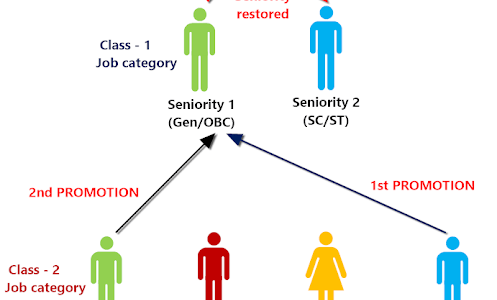
‘Catch-Up’ principle and ‘Consequential Seniority’ in Promotion

The Hon’ble Supreme Court in the case of Indra Sawhney & Ors. Vs. Union of India & Ors, reported in 1992 Supp.(3) SCC 217, held that Article 16(4) of the Constitution does not permit reservations in the matter of promotion. Thereafter, the Constitution (Seventy-Seventh) Act, 1995 came into force on 17.6.1995. Later on, the Hon’ble Supreme Court in the cases of Union of India & Ors. Vs. Virpal Singh Chauhan & Ors., reported in (1995) 6 SCC 684, Ajit Singh Januja & Ors. (Ajit Singh-I) Vs. State of Punjab & Ors., reported in (1996) 2 SCC 715 and Ajit Singh (II) & Ors. Vs. State of Punjab & ors., reported in (1999) 7 SCC 209, introduced the catch-up rule and held that if the senior general candidate is promoted then he will regain his seniority on promotion post above junior reserved promotes. It was also held that consequential seniority on promotion post is not covered by Article 16(4A).

Continue reading “‘Catch-Up’ principle and ‘Consequential Seniority’ in Promotion” →