Himachal Law Journal: September

Himachal Law Journal masthead beside the snow-covered Tudor-style Himachal Pradesh High Court building.

The Himachal Pradesh High Court’s recent decisions address the limits of personal upgradation in cadre appointments, finality in execution proceedings and recovery of admitted government dues. This edition also revisits three important decisions from the Himachal Law Archive concerning contractual-service seniority, environmental safeguards and inter se seniority in the judicial service.

Continue reading “Himachal Law Journal: September” →

Himachal Law Journal: UGC Rules, Regularisation and Recruitment

Himachal Law Journal masthead beside the snow-covered Tudor-style Himachal Pradesh High Court building.

The Himachal Pradesh High Court’s latest judgments address the limits of State control over university appointments, the rights of workers retained for decades on temporary terms, and recruitment conditions introduced through departmental clarifications. Here are the six decisions most relevant to practitioners and public authorities.

State Cannot Control Vice-Chancellor Selection Contrary to UGC Rules: HP High Court

The Himachal Pradesh High Court has invalidated key provisions governing the appointment of Vice-Chancellors to the State’s two agricultural universities. The Court held that the State could not redesign the selection process in a manner inconsistent with the UGC Regulations, 2018, and clarified that the Governor, when acting as Chancellor, performs an independent statutory function.

Internet Shutdowns and Fundamental Rights: The Test Under Articles 19 and 21

An internet shutdown is often described as a temporary step taken to control a difficult situation. For the person unable to make a payment, attend a class, contact a hospital, report the news or access a court website, however, the shutdown is anything but abstract. It is the law entering everyday life through a blank screen.

Continue reading “Internet Shutdowns and Fundamental Rights: The Test Under Articles 19 and 21” →

When a PIL Conceals a Private Contest: Himachal High Court’s ₹2 Lakh Warning

Public-interest litigation relaxes the traditional rules of standing, but it also places an unusually high burden of candour on the person invoking it. In Ajay Bhaik v. State of Himachal Pradesh, the Himachal Pradesh High Court found that this burden had not been met—and forfeited the petitioner’s deposit of ₹2 lakh.

Continue reading “When a PIL Conceals a Private Contest: Himachal High Court’s ₹2 Lakh Warning” →

From Funding to Forfeiture: Inside India’s FCRA Amendment Bill, 2026

Guest Author: Kaustubh Pratap Singh
Law Student, HP University

Editorial update (29 August 2026): Since this article was written, the Foreign Contribution (Regulation) Amendment Bill, 2026 has been referred to a Joint Parliamentary Committee on 12 August 2026. The discussion below analyses the Bill as introduced in the Lok Sabha on 25 March 2026.


Introduction

The Foreign Contribution (Regulation) Act, 2010 (“the Act” or “FCRA, 2010”) is the principal statute governing the acceptance and utilisation of foreign contribution and foreign hospitality by individuals, associations, and companies in India. Its long title records that it was enacted “to consolidate the law to regulate the acceptance and utilisation of foreign contribution or foreign hospitality by certain individuals or associations or companies and to prohibit acceptance and utilisation of foreign contribution or foreign hospitality for any activities detrimental to the national interest.”

Read more

Retrospective Regularization and Pay Fixation Benefits: A Win for Forest Guards

In a case that highlights the perils of administrative inefficiency and its impact on the fundamental right to equality, the Himachal Pradesh High Court delivered a landmark judgment in favor of Forest Guards who were left behind in the race for regularization. At the heart of the matter was a seemingly small, yet significant delay in regularizing the petitioners’ services—a delay that cost them the financial and professional benefits their counterparts in the Dharamshala Circle enjoyed. The courtroom battle underscored a critical question: should employees suffer because of administrative lapses beyond their control? The court’s answer was a resounding no.

Continue reading “Retrospective Regularization and Pay Fixation Benefits: A Win for Forest Guards” →

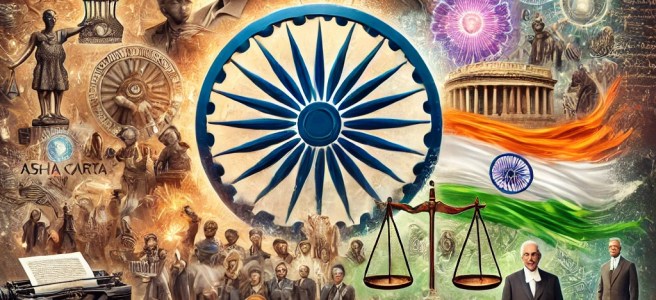
The Indian Constitution: A Masterpiece of Borrowed Wisdom and Indigenous Innovation

The Indian Constitution is more than a legal framework—it is a testament to the nation’s ability to weave together diverse influences into a coherent whole. It is, in essence, a symphony of ideas, where the wisdom of the ages merges seamlessly with the demands of modernity. As I reflect on this magnificent document, I am reminded of a sculptor chiseling away at a block of marble, revealing a form that is not only beautiful but enduring, adaptable, and deeply reflective of the people it serves.

At its core, the Constitution is a polyglot—a creation born out of a dialogue between India’s ancient civilizational ethos and the great constitutional experiments of the world. It reflects the evolution of human governance, from the flickering flames of Magna Carta to the revolutionary principles of liberty, equality, and fraternity espoused during the French Revolution. Yet, it is uniquely Indian, embodying the spirit of a civilization that has, for millennia, placed a high value on justice, equity, and the welfare of all living beings.

In borrowing from these various traditions, the Indian Constitution becomes more than just a document. It becomes a living organism, growing and evolving as our nation changes. In the words of Justice Felix Frankfurter, “The ultimate touchstone of constitutionality is the Constitution itself and not what we have said about it.” It is in this spirit that we must explore how this monumental text has guided us, not just in times of prosperity, but in moments of profound challenge and transformation.

Continue reading “The Indian Constitution: A Masterpiece of Borrowed Wisdom and Indigenous Innovation” →