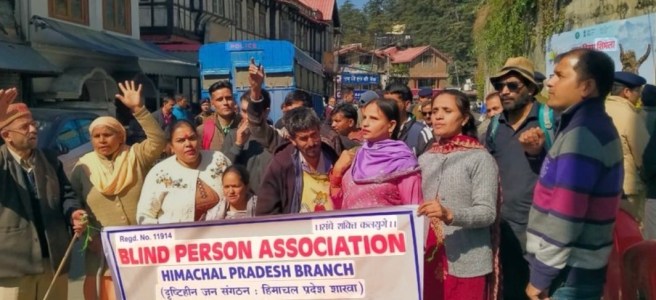
Nearly three years of protest, repeated demands over reserved vacancies, an unfinished disability-rights framework, and now a clear judicial direction: take effective steps to fill vacant Class-IV posts for visually impaired persons and issue the necessary advertisement.
There is a peculiar difference between a reserved post and a filled post.
The first exists in a statute, a roster, a government file or an affidavit. The second changes somebody’s life.
For visually impaired persons in Himachal Pradesh, that distance between the two has become the subject of an extraordinary struggle—one that has moved from representations and RTI applications to a prolonged street protest in Shimla, and ultimately into the continuing proceedings before the Himachal Pradesh High Court in CWPIL No. 12 of 2019, Court on its Own Motion v. State of Himachal Pradesh & Others.
On 31 August 2026, that journey produced an important judicial direction.
After examining the State’s position concerning vacancies for persons with disabilities, the Division Bench of Chief Justice G.S. Sandhawalia and Justice Chirag Bhanu Singh directed the State to take effective steps, in the first instance, to fill vacant Class-IV posts for visually disabled persons and to issue the necessary advertisement before the next date of hearing.
The Court also returned to another question that goes to the heart of disability-rights enforcement in the State: the status of the independent State Commissioner for Persons with Disabilities under the Rights of Persons with Disabilities Act, 2016.
The two issues may appear different. They are not.
One concerns whether a statutory reservation actually becomes employment. The other concerns whether there is an effective statutory institution capable of watching over implementation when it does not.
The next hearing is fixed for 27 October 2026.
The case did not begin with the Blind Persons Association
CWPIL No. 12 of 2019 is a suo motu public interest proceeding of the Himachal Pradesh High Court. The Blind Persons Association, Himachal Pradesh Branch did not institute the original PIL.
The proceeding had already developed into a wider judicial examination of the State’s implementation of disability rights, including accessibility of public infrastructure and implementation of the Rights of Persons with Disabilities Act, 2016. Government material relating to the proceeding also records directions concerning the Accessible India Campaign and accessibility audits.
Over time, however, the case began asking a deceptively simple question:
What does compliance with a disability-rights statute actually look like on the ground?
The answer increasingly required the Court to look beyond statutes and government assurances, to buildings, computer systems, recruitment figures, statutory institutions and eventually the experience of persons with disabilities themselves.
From accessibility on paper to accessibility on the ground
By 2024, the Court’s attention had turned sharply towards implementation.
On 20 August 2024, the Court called for the recent annual report of the State Commissioner under the RPwD Act and the action plans prepared by the State Government and local authorities under Section 45(2).
When the matter returned on 30 September 2024, the Court noted the absence of the Section 45(2) action plan and moved towards an expert audit of physical and technical infrastructure, including computer systems. The exercise extended to the High Court and District Courts as well.
The importance of this approach should not be underestimated.
Accessibility law often fails in the space between an architectural drawing and an actual doorway. A building may be described as “accessible”; a wheelchair may still not enter its toilet. A Government website may technically exist; a screen reader may still be unable to navigate it.
Subsequent proceedings exposed precisely such implementation questions. The litigation was evolving from formal compliance to functional compliance.
The broader national context was also changing. In Rajive Raturi v. Union of India, the Supreme Court’s 8 November 2024 judgment revisited the accessibility framework under the RPwD Act and the mandatory character of accessibility obligations.
Then another dimension moved to the foreground in the Himachal proceedings: employment.
Meanwhile, outside the courtroom, a protest was growing
Long before their participation in the PIL, visually impaired persons in Himachal Pradesh had been pursuing the Government over reserved and backlog vacancies.
This was not a protest that appeared suddenly after a court case.
Government records show that a meeting with representatives of the Blind Persons Association, Himachal Pradesh and the National Federation of the Blind had been held under the chairmanship of the Chief Secretary on 21 December 2021. Following that meeting, the Personnel Department issued a communication dated 6 January 2022 seeking information regarding backlog and shortfall of persons with disabilities from departments and other establishments. Official Government communication.
By February 2024, the issue remained alive. The State Government publicly recorded that Social Justice and Empowerment Minister Dr. (Col.) Dhani Ram Shandil had directed departments to identify vacant backlog posts for persons with benchmark disabilities and take steps for filling them. The meeting concerned demands raised by the Blind Persons Association and National Federation of the Blind. Himachal Pradesh Government press release.
Yet the protest continued.
In June 2024, more than 100 activists demonstrated near the Secretariat. One Association member told The Tribune that the protest had already continued for 240 days.
By 24 July 2024, protesters said they had been sitting peacefully near Kalibari for 274 days. That day’s protest again reached the Secretariat and disrupted the Chotta Shimla–Sanjauli road.
The agitation did not disappear with the changing calendar.
In April 2025, the Association said the protest had completed 535 consecutive days. Protesters again demonstrated in Shimla, saying repeated meetings and assurances had not produced the recruitment they were seeking.
Later reports described the agitation crossing 700 days, and in January 2026 the visually impaired were reported to have been protesting for more than 800 days, including the long-running dharna near Kalibari.
By April 2026, protesters were reporting 902 days of agitation. On 16 June 2026, the figure reported from the protest had reached 976 days. Public reporting in August 2026 continued to describe the struggle as extending for nearly three years.
The precise day-count is less important than the institutional fact it reveals. This was not simply litigation about vacancies. It was litigation arriving after years of attempts to make vacancies matter.
The Association started looking for the numbers itself
One of the more significant aspects of the Blind Persons Association’s campaign was its use of the Right to Information Act.
Instead of limiting itself to asking Government to “give jobs”, the Association collected information regarding sanctioned strength across numerous departments and cadres.
- State Taxes and Excise;
- Panchayati Raj;
- Food, Civil Supplies and Consumer Affairs;
- Prosecution;
- Youth Services and Sports;
- Agriculture;
- Health and Family Welfare;
- Horticulture;
- Industries; and
- Education.
Some of the figures were substantial. The Agriculture material reported 1,665 sanctioned Class-III posts and 781 Class-IV posts. Industries reported 644 Class-III and 447 Class-IV posts. Youth Services and Sports reported 163 Class-III and 83 Class-IV posts. Material concerning the Education establishment disclosed particularly large Class-III and Class-IV strengths.
But there is an important legal distinction.
These RTI replies establish sanctioned strength. They do not, standing alone, prove the number of visually impaired backlog vacancies.
To determine the latter, one needs the applicable reservation roster, actual representation of persons with benchmark disabilities, identified posts, recruitment history, carry-forward vacancies, interchange where legally permissible, and any applicable exemption.
That distinction matters because disability reservation cannot responsibly be calculated by taking a large departmental headcount and mechanically applying one per cent to it.
What the RTIs did achieve was something different: they exposed the need for a department-by-department reconciliation.
The Association’s April 2025 representation
Armed with this information, the Blind Persons Association submitted a representation dated 4 April 2025 to the Chief Minister, Social Justice and Empowerment Minister, Chief Secretary and Additional Chief Secretary concerned.
Its central demand was implementation of the reservation available to visually impaired persons.
Section 33 of the Rights of Persons with Disabilities Act, 2016 requires the appropriate Government to identify posts which can be held by the respective categories of persons with benchmark disabilities, constitute an expert committee with representation of persons with benchmark disabilities, and periodically review identified posts.
Section 34 provides for not less than four per cent reservation in Government establishments in the manner specified by the provision. Within that framework, one per cent concerns persons with benchmark disabilities falling in the category of blindness and low vision. Section 34(2) also contains the statutory mechanism governing carry-forward of an unfilled reserved vacancy and, thereafter, interchange among the specified disability categories in the circumstances contemplated by the provision. Read the Rights of Persons with Disabilities Act, 2016 on India Code.
The Association’s demand was therefore increasingly becoming a question not simply of Government policy but of demonstrable statutory accounting:
How many posts exist? How many were identified? How many reservation points arose? How many were filled? How many remain vacant? And how many fall to be dealt with as backlog vacancies under the statutory scheme?
The High Court begins looking at the employment figures
By 4 December 2025, employment reservation had become a concrete part of the proceedings.
The State’s compliance material recorded that 12 departments, corporations and boards had reported filling 153 posts reserved for persons with disabilities, including 61 posts from the visually impaired category.
The same material disclosed 97 reserved posts lying vacant, including 30 for visually impaired persons, and identified 50 backlog posts, of which 14 related to the visually impaired category.
The State also referred to a biannual recruitment schedule and steps being taken to fill vacancies. The Court directed that the needful be done at the earliest.
Those figures were important, but they were not the end of the inquiry. Later Government figures would change substantially as information from more departments was compiled. That is precisely why the quality and scope of the underlying data matter as much as the headline number.
The Government’s figures also began to change
By June 2026, Social Justice and Empowerment Minister Dhani Ram Shandil was reported as stating that around 311 posts for visually impaired persons were vacant across Government departments, with recruitment against 174 posts said to be at an advanced stage.
The protesters, meanwhile, had publicly claimed a much larger figure, around 1,100 posts.
The protesters’ figure is a claim attributed to the Association and its representatives in media reports. The figure of approximately 311 was the Government’s publicly stated position in June 2026. The figures appearing in High Court affidavits have their own scope and dates.
A serious analysis therefore requires reconciliation rather than arithmetic.
The Association enters the PIL
The Blind Persons Association eventually sought participation in CWPIL No. 12 of 2019. By 23 July 2026, the High Court ordered impleadment of the association in CMP No. 1335 of 2026.
That hearing became a significant turning point.
The Court recorded the submission made on behalf of the Association that the State was not specifying the vacancies of Class-IV employees and the status of their recruitment, particularly in relation to persons suffering from blindness.
The Court also recorded the 19 June 2026 meeting held under the chairmanship of the Minister for Social Justice and Empowerment with the Blind Persons Association and National Federation of Blind.
The Court consequently directed the Director, ESOMSA to file an affidavit showing whether further progress had been made in filling Class-IV posts from the Blind Category.
The State’s existing affidavit referred to 172 posts being filled through various advertisements. But the Court noted that the affidavit did not depict the complete picture, including the dates of advertisements and the status of recruitment. A fresh affidavit was ordered.
This was an important procedural shift. The question was no longer simply, “Is the Government taking steps?” It was becoming: Which posts? Which advertisement? What stage? What result?
That is the difference between an assurance and an audit.
The other unfinished business: the State Commissioner
The 23 July order revealed another significant problem.
The State’s compliance affidavit dated 16 May 2026 indicated that an independent State Commission/Commissioner arrangement for Persons with Disabilities had not been created, that the matter remained under consideration and that no separate establishment or dedicated staff had been created.
Counsel for the Association questioned the delegation of the relevant powers to the Director, ESOMSA under the notification dated 18 June 2024.
This was not merely an argument about nomenclature.
Chapter XII of the RPwD Act deals with the State Commissioner for Persons with Disabilities. Section 79 provides for appointment of the State Commissioner and the institutional assistance contemplated for the office. Section 80 assigns substantial functions to the Commissioner such as, examining laws and policies inconsistent with the Act, inquiring into deprivation of disability rights, reviewing safeguards, recommending remedial measures and monitoring implementation of the Act and disability schemes and programmes.
There was also significant Supreme Court history behind this issue.
In Seema Girija Lal v. Union of India, 2023 SCC OnLine SC 854, the Supreme Court on 17 July 2023 examined nationwide implementation of the RPwD Act. The compliance material before it identified Himachal Pradesh among the jurisdictions where an independent Commissioner under Section 79 had not been appointed, and the Supreme Court issued time-bound directions concerning appointments. Read the Supreme Court order.
The Commissioner is supposed to be part of the machinery that prevents every disability-rights grievance from having to become a High Court case.
31 August 2026: the Court moves towards a concrete recruitment direction
When the PIL returned on 31 August 2026, the State filed another affidavit.
The Court noted that the affidavit referred to filling 172 posts reserved for persons with disabilities, with different recruitment processes stated to have commenced between December 2025 and April 2026.
But the Court again looked beyond the aggregate number.
It examined the chart at page 485, Annexure R-1, and specifically noted that it related to 36 departments only. The chart showed filled and vacant posts across disability categories, including visually impaired persons.
That small word—“only”—may prove important.
If the State’s chart covers 36 departments, the eventual compliance exercise must make clear whether those 36 constitute the complete universe relevant to the exercise or whether other Government establishments remain to be reconciled.
A proposal to fill the vacancies—and the Government’s objection
The 31 August order records another revealing development.
The Director, ESOMSA had written on 8 July 2026 seeking one-time approval to fill all posts reserved for persons with disabilities in Group-C and Group-D categories.
According to the State’s affidavit, the proposal was declined on the ground that allowing all vacant posts of a particular reserved category to be filled in one go would be discriminatory.
The Association placed another example before the Court. Punjab, it was pointed out, had undertaken a special drive for Group-D services for visually impaired persons.
The High Court’s response was memorable:
“where there is a will, there is a way.”
It is a short sentence, but it captures much of the case.
Disability legislation in India is no longer new. The difficult question is no longer whether rights have been legislated. It is whether administrative systems have been organised to deliver them.
The Class-IV direction
The most consequential part of the 31 August order appears in paragraph 9.
For the moment, the Court expressly confined its focus to visually impaired persons. It recorded the submission concerning the particular disadvantage faced by some visually impaired Class-IV aspirants because inadequate educational opportunities may prevent them from qualifying for higher posts.
The Court then directed that effective steps be taken, “at the first instance,” to fill vacant Class-IV posts for visually disabled persons and that the necessary advertisement be issued before the next date of hearing.
The Court simultaneously referred to Section 33 concerning identification of posts and Section 34 concerning reservation and directed the State to take necessary effective steps.
This is what makes the latest order different from another round of status reporting.
The Court has identified a concrete next act: advertisement.
A vacancy hidden inside a departmental chart cannot be applied for.
An advertised vacancy can.
Why Class-IV employment matters particularly
One of the longer-term questions is whether identification of posts and recruitment practices are themselves opening sufficient opportunities for persons with blindness and low vision across different levels of Government employment.
The immediate Class-IV issue has a particular social context. The Court itself recorded the argument concerning visually impaired aspirants who, because of inadequate educational opportunities, may not be in a position to compete for higher posts.
For such candidates, prolonged non-recruitment against an entry-level reserved vacancy has consequences far beyond delay. Most of the visually impaired are not eligible for Higer grade posts as they don’t have the requisite qualifications due to barriers to higher education. Being eligible for only Class IV posts, advertisements and vacancies in higher grades go on getting unfilled. Further no vacancies of class IV are advertised or filled through special drives as contemplated in the act.
Employment means income, independence, social security and participation. A backlog vacancy may look like a statistic to an establishment branch. To an unemployed person who has waited years for recruitment, it represents time that cannot be restored.
And what happened to the State Commissioner?
The recruitment direction was not the only important feature of the 31 August hearing.
The Court noted that the State’s affidavit dated 24 August 2026 did not address the appointment of the independent State Commissioner, despite the earlier order dated 23 July.
The Court specifically referred to Section 79, dealing with appointment of the State Commissioner, and Section 80, specifying the Commissioner’s functions. It also recorded reliance upon the Supreme Court’s decision in Seema Girija Lal.
The issue is not bureaucratic. An effective statutory Commissioner is relevant when a disability roster is not implemented, an identified post is not advertised, a recruitment system becomes inaccessible, a public building remains inaccessible, or a policy operates inconsistently with disability rights.
Without an effective statutory watchdog, enforcement risks becoming episodic. The individual must write another representation, hold another meeting, file another RTI, organise another protest, or approach another court.
That is why the two principal issues in the present case belong together:
Jobs provide the immediate remedy; institutions determine whether the same battle must be fought again.
The numbers now need reconciliation, not rhetoric
The next phase of this litigation should increasingly be about data.
The record contains several sets of figures generated at different stages and for different purposes: departmental RTIs obtained by the Association regarding sanctioned strength; the December 2025 figures concerning filled, vacant and backlog PwD posts; later Government statements concerning visually impaired vacancies and recruitment; the subsequent affidavit referring to recruitment concerning 172 PwD-reserved posts; and the 36-department chart examined by the Court on 31 August 2026.
These figures should not be casually compared as though each measures the same thing. They may relate to different dates, departments, disability categories, vacancy classifications or stages of recruitment.
What is needed is a single auditable chain for every relevant establishment:
sanctioned cadre → identified posts → reservation roster → posts filled → current vacancies → backlog vacancies → advertisement → selection → appointment.
Once that chain exists, compliance becomes measurable. Until then, large aggregate figures can create the appearance of precision without necessarily answering the question that matters.
What should the State now be expected to demonstrate?
The 31 August order itself requires effective steps for filling vacant Class-IV posts for visually impaired persons and issuance of the necessary advertisement before the next hearing.
Meaningful compliance should therefore make it possible to ascertain the total number of relevant Class-IV vacancies; the departments and establishments in which they exist; the nomenclature and identification of the posts under Section 33; whether the advertisement covers the complete set of vacancies or only a subset; the treatment of earlier backlog vacancies under Section 34; whether the 36 departments represented in the State’s chart constitute the complete exercise; and the recruitment timeline from advertisement to actual appointment.
Separately, on the institutional side, the State will have to place a clear position before the Court concerning the State Commissioner for Persons with Disabilities and the compliance claimed with Sections 79 and 80 and the Supreme Court directions relied upon in the proceedings.
A case about ramps, jobs—and the architecture of equality
CWPIL No. 12 of 2019 is becoming an instructive example of how disability-rights litigation changes when courts begin examining implementation rather than declarations.
The case has dealt with inaccessible buildings. It has dealt with court infrastructure. It has dealt with accessibility audits. It has examined disability facilities. It has examined the State Commissioner. And it has now reached reserved employment.
These subjects are connected by one principle:
Equality is not achieved merely by allowing a person with a disability to exist inside a system designed without them. The system itself must be capable of including them.
A ramp that cannot be used is not meaningful accessibility.
A statutory watchdog that cannot effectively perform the functions contemplated by law raises questions about meaningful oversight.
And a reserved post that remains indefinitely vacant is not meaningful reservation.
From Kalibari to the High Court
Perhaps the most striking feature of the story is its geography.
For years, visually impaired protesters sat near Kalibari in Shimla. From there, their demonstrations repeatedly travelled towards the Secretariat. Roads were blocked. Meetings were held. Government assurances followed. RTIs were filed. Representations were submitted.
Eventually, the Blind Persons Association entered an existing High Court proceeding dealing with implementation of disability rights.
The 23 July 2026 order recorded its concerns about Class-IV vacancies.
The 31 August 2026 order went further. The Court considered the State’s position on the one-time proposal, examined the vacancy chart, considered the Punjab example and then directed advertisement of Class-IV vacancies for visually impaired persons before the next hearing.
That does not mean the struggle is over.
An advertisement is not an appointment. A recruitment process is not completed merely because it has begun. And an affidavit reporting progress is not a substitute for demonstrable compliance.
But something important has changed.
After years in which the central demand was “fill the vacancies”, the judicial record now contains a direction requiring the State to take a concrete step towards doing precisely that for Class-IV visually impaired candidates.
What 27 October will test
When the case returns on 27 October 2026, the real question should be relatively easy to state.
Has the order translated into action?
Has the advertisement been issued? How many vacancies does it cover? Which departments are included? What remains outside the recruitment exercise? What has happened to the backlog? And what concrete position has the State placed before the Court concerning the State Commissioner for Persons with Disabilities?
These are questions about compliance, but they are also questions about the credibility of rights.
India does not suffer from an absence of disability legislation. The Rights of Persons with Disabilities Act is detailed, rights-oriented and institutionally ambitious. The recurring difficulty is the distance between what the statute promises and what an individual can actually use.
For a visually impaired person waiting for employment, the ultimate measure of this litigation will therefore not be the number of affidavits filed, meetings convened or vacancy charts prepared.
It will be simpler.
An identified post must become a reserved post.
A reserved post must become an advertised post.
An advertised post must lead to a fair selection.
And a statutory right must have an institution capable of defending it.
After years of protest, the Himachal Pradesh High Court has now pushed one part of that journey from the file towards the advertisement.
The next question is whether the advertisement will finally lead to the appointment letter.
Case at a Glance
Case: Court on its Own Motion v. State of Himachal Pradesh & Others
Case No.: CWPIL No. 12 of 2019
Latest substantive order discussed: 31 August 2026
Coram: Chief Justice G.S. Sandhawalia and Justice Chirag Bhanu Singh
Association: Blind Persons Association, Himachal Pradesh Branch
Counsel recorded on 31 August 2026 for applicant in CMP No. 1335/2026: Deven Khanna, Prashant Sharma and Sambhav Bhasin, Advocates
Principal legislation: Rights of Persons with Disabilities Act, 2016
Key provisions: Sections 33, 34, 79 and 80
Next date: 27 October 2026
Key Takeaway
The High Court has directed effective steps for filling vacant Class-IV posts for visually impaired persons, including issuance of the necessary advertisement before the next hearing, while simultaneously scrutinising the unresolved State Commissioner issue. The case now presents a larger test of whether statutory disability rights in Himachal Pradesh can be translated from reservation rosters and compliance affidavits into accessible institutions and actual employment.
Disclosure: Advocate Deven Khanna, publisher of LawUmbrella, appears for the Blind Persons Association in the proceedings discussed above. This article distinguishes the Association’s claims and submissions from findings and directions recorded by the Court.
Prepared for LawUmbrella as a legal analysis and public-interest case feature. The matter remains pending. References to the Court’s directions should be read with the official orders, and media-reported vacancy figures are identified as such.
#HimachalHighCourt #DisabilityRights #VisuallyImpaired #BlindPersonsAssociation #RPwDAct #RightToEmployment #PwDReservation #BacklogVacancies #Accessibility #EqualOpportunity #PublicInterestLitigation #HimachalPradesh #LawUmbrella


One thought on “From Protest to Recruitment: How Himachal’s Blind Community Took the Disability Rights Gap to the High Court”