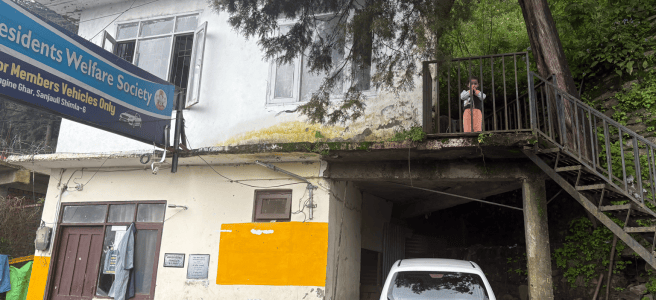
There are public interest cases that begin with petitions, affidavits and carefully numbered grounds. This one began with a citizen who looked at what was happening below Sanjauli and decided that somebody ought to know.
The complaint concerned Bangala Colony in Shimla. The allegations were hardly subtle. Construction was said to be taking place on forest and public land. Green areas were being cemented. Deodar trees were allegedly being damaged. Pathways were being obstructed. Garbage and wastewater had become part of the grievance. Structures, the complaint said, were steadily occupying land that was not meant to be privately built upon.
The citizen first approached the local administration. When an effective answer did not follow, the grievance reached the Himachal Pradesh High Court. The sender chose anonymity, citing apprehensions about personal safety.
The Court did not treat anonymity as a substitute for evidence. It did something more useful. It sent someone to look.
The Court Sends Its Eyes to the Ground
On 18 August 2025, the High Court directed the Secretary of the District Legal Services Authority, Shimla, to inspect the locality and submit a report with photographs. A report was also called from the district administration.
That order changed the character of the case. Rather than allowing the dispute to remain an exchange of allegations and official replies, the Court called for an independent inspection of the ground itself.
The DLSA Secretary went to Bangala Colony with officials from the Revenue Department, Municipal Corporation, Forest Department and other agencies. A second inspection followed after demarcation. What emerged was a picture of the locality that was considerably more vivid than anything a routine office file could convey.
What the Inspection Found
Roughly 30 houses and sheds were noticed. Some were kacha or semi permanent. Others were cemented, permanent and double storeyed. A drain descended through the settlement. Construction and drainage were found in close contact with standing deodar trees. The public pathway had been narrowed at places and a projecting grill created a pedestrian hazard. Household wastewater was seen flowing directly onto a public cemented path. Garbage, foul smell and dirty water also found their way into the inspection record.
These details mattered because they gave physical form to what might otherwise have remained a familiar exchange of allegations and denials.
A tree does not know which department owns the file concerning it. A pedestrian does not care which branch is responsible for a blocked path. Wastewater does not wait for correspondence between departments before flowing downhill.
The inspection forced administrative categories to confront physical reality.
Then the Survey Instruments Came Out
In encroachment litigation, accusation is easy. Measurement is harder.
Revenue officials demarcated the area in the presence of the concerned departments. The settlement ceased to be a blur of buildings on a hillside. Structures acquired measurements, boundaries and legal identities.
The records then revealed another problem. Land transferred by a Government notification to the Forest Department years earlier was still reflected differently in the revenue record. The Government had transferred the land. Its records had apparently missed the memo.
Not for a few weeks. For years.
The Forest Department Had Been Writing Letters
The later Forest Department affidavit made this part of the story particularly revealing. The Department placed before the Court a trail of correspondence stretching over several years in which correction of the revenue entries had been sought.
Letters were written. Further communications followed. Reminders followed those communications. Yet the entries remained uncorrected.
There is something almost classically bureaucratic about land becoming forest by Government notification while continuing, year after year, to wear its old name in another Government register. On the ground, however, the consequences were anything but comic.
Unclear records can produce unclear responsibility. Unclear responsibility can produce convenient silence. Public land is often lost in precisely that silence.
Twenty Three Structures on Forest Land
The investigation eventually produced a figure the Court could no longer ignore. Twenty three structures or dharas were identified on forest land.
The Forest Department described them as illegal. The identified encroachment extended over 822.52 square metres. The Department instituted separate encroachment proceedings before the competent authority. Notices were issued and hearings commenced.
A complaint that began with a request to inspect had reached the stage of statutory proceedings against identified occupations.
And the Forest Was Carrying the Scars
The Forest Department also reported why this was not simply a dispute about possession. Cement and concrete had spread around structures. Approximately 21 trees were reported affected. Concrete had been laid around some. Open drains ran at the base of others. Some trees had effectively been incorporated into structures.
This is one of the quieter ways an urban forest disappears. It need not begin with the dramatic felling of an entire hillside. Sometimes it happens through a hundred small accommodations. A wall comes up here. A slab appears there. A drain runs against a trunk. There is a little less soil and a little more concrete.
The tree remains standing, so everyone can continue calling the area green. Until one day it does not.
Then the File Turned Around
The DLSA exercise separately identified 10 structures on Municipal Corporation land. Before those structures could become the centre of the case, however, the investigation encountered another building. It belonged to the institution expected to enforce municipal law.
A Municipal Corporation Ward Office.
The land on which it stood had already been transferred to the Forest Department. The Corporation’s own affidavit supplied an uncomfortable chronology. Public money had been spent on the Ward Office and later additions. Most significantly, the Corporation admitted that there was no sanctioned building plan.
The Corporation sought to explain that the process had begun earlier and that the construction had been undertaken bona fide. There was one obvious difficulty. The authority asking for indulgence was the authority ordinarily expected to deny such indulgence to everyone else.
The file had turned around.
When Juvenal Arrived in Sanjauli
On 10 September 2026, a Division Bench comprising Chief Justice G.S. Sandhawalia and Justice Bipin C. Negi examined the accumulated record. The Court noted that the Municipal Corporation’s Ward Office had been raised without a sanctioned building plan and was apparently unauthorised. It declined the request that the irregularity simply be overlooked or regularised.
“Quis custodiet ipsos custodes?”
Who will guard the guards?
The phrase, conventionally traced to the Roman satirist Juvenal, has travelled a considerable distance from ancient Rome. Its modern force lies in a problem common to every system of public power. What happens when those entrusted to enforce the rules become participants in their breach?
There could hardly have been a more literal setting for the question. The authority expected to regulate construction was explaining its own unsanctioned building.
The watchdog had left paw prints at the scene.
When the question arose in Court, the answer was found somewhere much simpler than a statute book. It was found in the opening words of the Constitution of India.
“We, the People.”
In this case, that answer was not merely rhetorical. It described what had actually happened.
“We, the People” Was Not a Metaphor Here
The proceedings did not begin because an internal audit discovered the Ward Office. Nor did they begin because the Municipal Corporation voluntarily surveyed its land or because the Forest Department suddenly detected every structure.
They began because a citizen complained.
The citizen did not adjudicate title or order demolition. The citizen did something much more elementary and, in a democracy, indispensable. The citizen asked the State to look.
When the ordinary machinery did not produce an adequate answer, the constitutional machinery did.
The Court called for evidence and independent verification. The DLSA inspected the site. Revenue officials demarcated the land. The Forest Department disclosed its records. The district administration and the Municipal Corporation placed their positions before the Court. An old Government notification finally acquired practical consequences.
That is how “We, the People” works in constitutional practice. It does not mean that every citizen’s complaint is correct. It means that public institutions remain answerable within a constitutional order whose authority ultimately comes from the people.
Public Interest Litigation as an Audit Trail
No single document solved the Bangala Colony problem. The citizen raised the alarm. The Court ordered verification. The DLSA supplied the picture on the ground. Demarcation supplied the boundaries. The State’s affidavits exposed the state of the records. The Forest Department quantified the encroachment and disclosed the pending proceedings. The Municipal Corporation’s affidavit supplied the admissions about its own building.
One piece of paper tested another. One institution’s record exposed an omission in another. With each stage, the room for vague explanation became smaller.
Accountability emerged not as a thunderbolt but as an audit trail.
The High Court’s Order and the Symbolism of Demolition
The order dated 10 September 2026 converted that audit trail into concrete directions.
- The competent authority was directed to process the 23 pending forest encroachment cases for removal.
- The Municipal Corporation was directed to take steps to demolish its Ward Office and restore the area to its original form.
- The Corporation was directed to initiate proceedings in accordance with law for removal of the 10 other structures on Municipal Corporation land.
- The Court directed that responsibility be fixed upon the officers and officials involved in the Ward Office construction, where public money had been spent despite the absence of a sanctioned building plan.
- The Court directed that the long overdue mutation be entered in favour of the Forest Department in terms of the Government notification.
The direction concerning the Ward Office is more than an instruction about bricks and mortar. It is symbolic of the rule of law itself. The law has meaning only when the same standard binds the citizen and the authority that enforces it. A municipal body cannot demand sanctioned construction from the public while treating its own unsanctioned building as an institutional exception. The proposed removal of the Ward Office is therefore a small but unusually visible testament to a large constitutional proposition. The State is under the law, not above it.
There is an important symmetry here. Demolition by public authorities must itself remain subject to due process and the discipline of law. At the same time, unauthorised construction does not become immune merely because the builder happens to be a public authority. The rule of law runs in both directions.
The matter is listed for compliance on 17 November 2026.
There Is a Lesson in What the Court Did Not Do
The Court did not order every private structure bulldozed by judicial fiat. The forest structures are already the subject of statutory proceedings and those proceedings must reach their lawful conclusion. The structures on Municipal Corporation land require proceedings in accordance with law and the appropriate procedure.
The Ward Office stood on a different footing. The Corporation’s own admissions were before the Court, and the Court directed the Corporation to take steps to demolish its own building and restore the land.
The distinction matters. The rule of law is not vindicated by replacing administrative inaction with administrative arbitrariness. Private occupants remain entitled to the procedure the law gives them. The State, however, cannot insist upon legal discipline for the citizen while seeking indulgence for itself.
There is a certain symmetry in the Municipality being asked to begin its enforcement exercise at home.
Thirty Three Buildings, But One Explains the Case
The numbers are striking. There are 23 structures on forest land, 10 on municipal land, 822.52 square metres of identified forest encroachment and approximately 21 affected trees.
Yet none of those figures captures the case quite as neatly as the Ward Office. It matters not because it is necessarily the largest structure, but because it collapses the comfortable distinction between regulator and regulated.
If a private person constructs without sanction, the Municipality is expected to act. If someone occupies forest land, the Forest Department is expected to act. If public records are wrong, the administration is expected to correct them.
If none of this happens for long enough, each department can eventually point towards another file.
The Ward Office made that arrangement difficult. The question could no longer be, “Why did you fail to stop somebody else’s building?” It became something much simpler. “Please explain your own.”
The Next Chapter Is Compliance
The order of 10 September 2026 is not the end of the proceedings. It is the point at which investigation becomes enforcement.
When the matter returns, the questions will be considerably less philosophical. What happened to the 23 encroachment cases? What proceedings were initiated concerning the 10 municipal structures? Has the Ward Office been demolished? Has the land been restored? Whose responsibility has been fixed? Has the revenue record finally been corrected?
Those answers will determine whether the litigation changed only the file or also the hillside.
That is ultimately the measure of environmental litigation. It is not the number of affidavits filed or the eloquence of the orders passed. It is what remains standing, what is removed, what is restored and whether the next tree needs another anonymous citizen to save it.
The Constitution begins with “We, the People.” Bangala Colony is a useful reminder that those words are not ceremonial decoration.
Sometimes they are a job description.
Related Articles
For more on public interest litigation and constitutional accountability in Himachal Pradesh, read LawUmbrella’s From Protest to Recruitment: How Himachal’s Blind Community Took the Disability Rights Gap to the High Court and follow the High Court Cases archive.
Follow LawUmbrella
Follow LawUmbrella for continuing coverage of this PIL, important Himachal Pradesh High Court orders, public interest litigation and environmental law.
Case Details
Case: Court on its own motion v. State of Himachal Pradesh & Ors., CWPIL No. 72 of 2025
Court: High Court of Himachal Pradesh at Shimla
Bench: Chief Justice G.S. Sandhawalia and Justice Bipin C. Negi
Latest Order: 10 September 2026
Source: Read the High Court’s order dated 10 September 2026.

 LawUmbrella