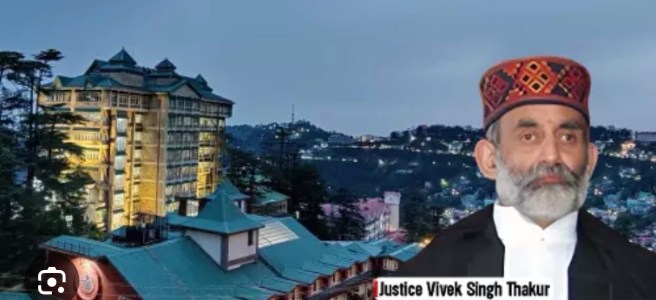
A court can reject a challenge to a major infrastructure acquisition without approving every step that remains to be taken. That is the essential distinction in the Himachal Pradesh High Court’s Gaggal Airport decision. The challenge to acquiring land for expanding Kangra Airport failed, but the Bench expressly insisted on the techno-economic feasibility process and necessary environmental clearances before project work could commence.
Gaggal Airport Expansion Affected Social Welfare Committee v. The Principal Secretary (Tourism & CA), Government of Himachal Pradesh & Others — CWP No. 7846 of 2023; 2026:HHC:49585. A reportable Division Bench judgment of Justice Vivek Singh Thakur and Justice Ranjan Sharma, authored by Justice Vivek Singh Thakur, reserved on 30 July 2026 and pronounced on 18 November 2026.
Read the judgment: Official Himachal Pradesh High Court PDF · Accessible full-text reproduction.
The judgment in brief
The petitioner committee sought to quash the preliminary acquisition notification dated 7 July 2023 and the Social Impact Assessment (SIA) process for expanding the existing Gaggal Airport. The Court first held that the committee had failed to establish its status, authority and standing to maintain an ordinary writ petition. It then considered the substantive objections and declined interference with the acquisition. The Bench accepted the distinction between securing land and beginning work under paragraph 2 of the Environmental Impact Assessment Notification, 2006. Yet it also warned of the risk of spending public money before feasibility and environmental scrutiny were completed, and directed the State to advance those processes promptly. The petition was disposed of; no environmental clearance was granted by the judgment.
Key references: paragraphs 143–161, 163–193 and the disposition in paragraph 194.
Why a runway expansion became a public-law dispute
Kangra Airport is not a proposed greenfield airport. It has operated at Gaggal since 1989, and the dispute concerned extending its runway and associated infrastructure. On the State’s request, the Airports Authority of India (AAI) conducted studies and prepared a draft master plan. The record speaks of a phased extension ultimately contemplated to a runway length of 3,010 metres, alongside works in and around Manjhi Khad, road diversions and the relocation of other infrastructure.
For residents and landowners, those engineering plans meant displacement of homes, farms, businesses and public facilities. The SIA report recorded serious social costs, including loss of livelihood and the need for rehabilitation and resettlement. It also discussed possible alternatives, including different runway alignment and locations away from the existing airport. The Multi-Disciplinary Expert Group nevertheless recommended proceeding with the proposed expansion, taking the view that its anticipated public benefits outweighed the adverse social impact.
The Government issued the Section 11 preliminary notification on 7 July 2023. The petitioner committee challenged both that notification and the SIA report dated 3 May 2023, which had been appraised by the Expert Group on 5 June 2023. Its alternative prayer was that, if the expansion served a public purpose, the other locations suggested during the SIA process should be considered.
The difference between the two kinds of relief is important. The primary prayer sought to invalidate the acquisition process itself. The alternative invited the Court to revisit the technical choice of location and alignment. Each required the Bench to confront a different limit of judicial review.
Judgment: paragraphs 1–28 and 47–57.
The legal questions before the Court
The judgment presents five closely connected questions. Could a committee, without clear registration, membership or authority, maintain an ordinary Article 226 petition in the name in which it sued? Did the SIA, public-consultation and acquisition process comply with the 2013 Act? Had the authorities lawfully considered the asserted alternatives and the need to acquire agricultural land? Was the public purpose sufficiently established? And did the absence of completed feasibility and environmental approvals make the acquisition notification illegal at this stage?
These issues should not be compressed into a single question of whether airport expansion was desirable. Some concern who was before the Court; others concern procedural safeguards; still others relate to the line between administrative expertise and judicial review. The environmental-clearance question turns substantially on sequencing rather than on any final assessment of the project’s environmental merits.
The statutory framework: social impact, objections and environmental approval
The principal acquisition statute was the Right to Fair Compensation and Transparency in Land Acquisition, Rehabilitation and Resettlement Act, 2013. The provisions canvassed in the proceedings included Sections 4 and 5, governing social impact assessment and public hearings; Section 7, concerning expert appraisal; Section 8, concerning consideration of the assessment; Section 10, addressing acquisition of irrigated multi-cropped land; Section 11, governing the preliminary notification; and Section 15, permitting objections to the proposed acquisition. The Himachal Pradesh Social Impact Assessment and Consent Rules, 2015 were also part of the governing framework.
These safeguards serve different purposes. The SIA process is designed to identify the human and social consequences of proposed acquisition. Expert appraisal considers the claimed public benefits against those costs. Section 15 objections permit affected persons to raise matters concerning the acquisition in the statutory process. Compensation, rehabilitation and resettlement are governed by additional provisions; they do not disappear merely because the project has a public purpose.
Environmental permission operated under a separate instrument: the Environmental Impact Assessment Notification dated 14 September 2006. The Court’s analysis focused on paragraph 2, under which securing land is distinguished from commencing the project or activity that requires prior environmental clearance. The legal question was therefore not whether the State could evade environmental approval, but whether it had to complete that approval before even acquiring the land.
Article 226 framed the Court’s jurisdiction. The petitioner invoked Articles 14, 21 and 300-A in challenging alleged arbitrariness, environmental consequences and deprivation of property. Those constitutional claims had to be examined against the specific pleadings, available statutory procedures and the identity of the person seeking relief.
What the petitioner argued—and how the respondents answered
The petitioner’s case: statutory safeguards cannot be treated as formalities
The committee’s criticism began with the SIA. Its counsel contended that the assessment had not adequately consulted affected families, had failed to examine the objections raised at public hearings, and had made questionable statements about consent and the area’s social and economic profile. Particular reliance was placed on the claimed effect of acquisition upon fertile and multi-cropped agricultural land, commercial establishments, public institutions and families facing displacement.
The petitioner also argued that the SIA team had visited the location before the formal notification authorising the assessment; that the Expert Group had not independently assessed the social consequences; and that viable alternatives had been dismissed without proper technical examination. The suggested options included extending towards Sarah–Dharamshala and considering sites around Bodkwalu and Lanj. The committee contended that alternatives could reduce displacement and public expenditure.
Environmental and engineering uncertainty formed another limb of its case. The petition raised the absence of a completed techno-economic feasibility report, environmental clearance and other regulatory approvals, together with concerns relating to Manjhi Khad, seismic sensitivity and river engineering. It disputed the strategic justification said to arise from possible Indian Air Force use and alleged that the acquisition was a colourable exercise designed primarily to benefit a privileged class of air travellers.
The petition further referred to land said to be affected by a highway acquisition, questioned the loss of existing public facilities, and invoked the safeguards of the 2013 Act and the constitutional protection of property. These were the petitioner’s submissions; the article does not treat their factual allegations as findings of the High Court.
Judgment: paragraphs 47–71 and rejoinder submissions at paragraphs 136–142.
The State’s response: a public project pursued under the 2013 Act
The State placed the airport’s existing operational constraints at the centre of its response. It pointed to the short runway, passenger demand, the need for safer operations and the anticipated benefits of improved connectivity for tourism, employment and local commerce. It relied on AAI’s surveys and master plan, the appointment of an SIA agency, public hearings, appraisal by the Expert Group and the Section 11 notification following governmental consideration.
The State disputed the allegation of statutory non-compliance. It maintained that objections under Section 15 were being considered and that compensation and rehabilitation issues were being addressed under the statutory scheme. It also contended that expansion at the existing airport was technically different from creating a new airport elsewhere and that environmental and engineering safeguards would be addressed at the appropriate project stage.
Its answer to displacement was not that displacement would be inconsequential. It asserted that compensation for land, structures and losses, together with rehabilitation and resettlement measures, would be administered under the 2013 Act. The existence and adequacy of those measures were therefore separate factual and legal matters, not an automatic consequence of the High Court rejecting this challenge.
Judgment: paragraphs 72–107.
AAI, the Union and NHAI: objections to standing and to the proposed alternatives
AAI’s response addressed feasibility and the nature of the approved programme. The proposed work was extension of the existing operational airport, while the suggested Lanj and Bodkwalu sites would require consideration of a new airport. Reorienting the runway, AAI said, raised difficult questions of wind direction, obstacles, river crossings, bridge spans, costs and disruption of current operations. AAI also explained that it would obtain the necessary statutory approvals before undertaking construction and commissioning.
The Deputy Solicitor General challenged the committee’s locus standi. He pointed out that the Gram Panchayat resolution authorised named individuals, not the differently named entity which filed the petition. He also raised non-joinder concerns concerning the SIA agency and Expert Group. NHAI answered the argument about overlap with highway acquisition by referring to the lapse of the relevant earlier highway notifications and raised a separate objection to the legal status of the petitioner committee.
Thus, the respondents did not rely upon one uniform defence. The State defended the acquisition procedure and public purpose; AAI addressed technical choices and future approvals; and NHAI contested the allegation of overlapping acquisition as well as maintainability. This distinction matters when identifying which factual assertion the Court accepted on a particular issue.
Judgment: paragraphs 115–135.
The case laws and precedents cited in the proceedings
The judgment records a substantial catalogue of authorities cited by counsel. That catalogue should not be mistaken for a list of precedents expressly applied by the Division Bench. The Court’s discussion of the cited decisions is chiefly contained in the summaries of submissions; its own analysis in paragraphs 143–194 principally proceeds by examining the record and the governing statutory provisions. The following authorities are significant because of the questions for which counsel invoked them.
Authorities invoked by the petitioner
1. Competent Authority v. Barangore Jute Factory, (2005) 13 SCC 477, and Chandra Kishore Jha v. Mahavir Prasad, (1999) 8 SCC 266, were cited for adherence to the manner of proceeding prescribed by statute. The petitioner’s point was that defects in a mandatory acquisition procedure could not be brushed aside as harmless departures from administrative practice. The High Court nevertheless found the particular irregularities alleged before it insufficiently established.
2. Raghbir Singh Sehrawat v. State of Haryana, (2012) 1 SCC 792; Kamal Trading Pvt. Ltd. v. State of West Bengal, (2012) 2 SCC 25; and Surinder Singh Brar v. Union of India, (2013) 1 SCC 403, were among the judgments relied upon in support of an effective opportunity to object in compulsory acquisition proceedings. They were cited to challenge the public-hearing and objection process. The Bench’s response was case-specific: it examined public hearings, the material before the Collector and whether the petitioning committee had shown a legally material procedural defect.
3. Hanuman Laxman Aroskar v. Union of India, (2019) 15 SCC 401, concerning environmental appraisal of an airport project, and Karnataka Industrial Areas Development Board v. C. Kenchappa, (2006) 6 SCC 371, were invoked in support of environmental scrutiny. Hanuman Laxman Aroskar is particularly instructive as a comparator because it concerns the integrity of the environmental-clearance decision-making process. The Gaggal Bench, however, addressed an earlier stage: the acquisition of land before final environmental approval, not judicial review of a completed clearance.
4. Project Director, Project Implementation Unit v. P.V. Krishnamoorthy, (2021) 3 SCC 572, and Sachidananda Pandey v. State of West Bengal, (1987) 2 SCC 295, were also cited for the petitioner’s public-law and environmental challenge. The judgment does not provide a separate, detailed application of each cited holding to the Gaggal facts. It would therefore be inaccurate to describe all these decisions as having been distinguished or overruled by the Bench.
Authorities invoked by the respondents
5. Ayaaubkhan Noorkhan Pathan v. State of Maharashtra, (2013) 4 SCC 465, was cited for the requirement that an ordinary challenger demonstrate a legal grievance or injury. This theme closely tracks the Bench’s eventual reasoning: the petitioner committee had shown neither the legal status and authority to sue in its own name nor a legal injury to itself. The Court’s actual finding rested on the documents—or absence of documents—before it, especially the committee’s unproved constitution and the defective authorisation.
6. Udit Narain Singh Malpaharia v. Additional Member, Board of Revenue, AIR 1963 SC 786; Prabodh Verma v. State of Uttar Pradesh, AIR 1985 SC 167; and Public Service Commission, Uttaranchal v. Mamta Bisht, (2010) 12 SCC 204, were relied upon in the context of necessary parties and defects in writ pleadings. Their relevance to the controversy was the absence from the proceedings of the SIA agency and expert body whose methodology and appraisal the petitioner directly attacked. The High Court expressly adverted to that non-joinder when rejecting the procedural allegations.
7. Narmada Bachao Andolan v. Union of India, (2000) 10 SCC 664, was included among the authorities cited by the Union’s counsel. It provides the broader setting for judicial review of technically complex public projects and the limits of substituting judicial preferences for policy and expert decisions. In Gaggal, the Bench declined to select an alternative runway location on its own assessment, while continuing to insist on compliance with the separate environmental approval regime.
These are Supreme Court authorities and must be distinguished from the High Court’s case-specific factual findings. They are included here because the parties relied upon them and their relevance can be identified from the judgment. The analysis should not be read as asserting that the Bench accepted every submission for which they were cited. The petitioner also referred to Vanashakti and Pristine Hotels and Resorts on environmental clearance; the judgment’s records concerning the precise dates and proceedings of the Vanashakti litigation require separate source verification before being used as an independent statement of that case’s operative holding.
Judgment references: petitioner’s authorities, paragraphs 64–71; respondents’ authorities, paragraphs 123–130; High Court analysis, paragraphs 143–194. For full citation context consult the original judgment.
The Court’s analysis: two grounds, not one
The committee could not establish that it was entitled to sue
The Bench first considered whether it had a properly constituted petitioner before it. No document established the committee’s registration, objects, membership or resolution authorising the litigation. The lone Panchayat resolution on record concerned Gram Panchayat Nandehar and authorised identified persons to take legal action on behalf of that Panchayat. It did not authorise the committee, in the name in which the writ petition was filed, to sue independently.
The distinction was sharpened by inconsistencies between the names of the office-bearers and the committee appearing in the resolution and those in the memorandum of parties. There was also no showing that the committee itself owned land or was otherwise legally injured by the proposed acquisition. The petition had been filed as an ordinary writ petition, not presented under the relevant procedure as a public interest litigation.
The Court expressly acknowledged that Article 226 may, in appropriate circumstances, be invoked by an unregistered body on behalf of persons unable to approach the Court. It found no material showing that the petitioning committee had brought itself within such an exception. Paragraph 160 therefore held the committee incompetent to maintain this petition.
Judgment: paragraphs 143–160.
The Bench nevertheless examined the acquisition challenge
Paragraph 161 is easily missed. Despite its conclusion on standing, the Bench chose to consider the merits. Its findings therefore provide guidance on the particular statutory objections and technical record, but must be read alongside the antecedent maintainability ruling. The case is not a general endorsement of every document or future decision associated with Gaggal Airport.
The Court rejected the allegation that visits allegedly undertaken by the SIA team before the 28 February 2023 notification had invalidated the assessment. It found no sufficient evidence establishing the alleged visits or any resulting legal prejudice. It also noted that the SIA agency and the Multi-Disciplinary Expert Group had not been impleaded despite the challenge to their methods and competence.
On alternative locations, the Bench accepted the crucial difference between expanding an existing operational airport and creating an entirely new one. Two suggestions concerned land away from the existing airport and so did not answer the programme of expansion being considered. The proposed reorientation of the existing runway raised engineering concerns documented by AAI. The Court refused to replace that technical assessment with the petitioner’s suggested configuration.
The claim under Section 10 concerning irrigated multi-cropped land failed against the Court’s acceptance of the public purpose and the need for adjacent land. The Bench also rejected the allegation that the project served only affluent passengers, and accepted the broader connectivity, safety and strategic considerations placed on record. The Court did not thereby quantify or extinguish the individual consequences of displacement.
The challenge based upon the absence of final environmental clearance met a different answer. Under paragraph 2 of the 2006 EIA Notification, securing land was distinguishable from beginning project activities. Acquisition at that stage was not itself prohibited by the absence of environmental clearance. The judgment nevertheless made clear that necessary environmental permissions remained prerequisites to commencing project work.
Judgment: paragraphs 161–190, especially 163–170, 175–177 and 187–188.
The ratio and its proper limits
The standing ruling is direct: this petitioner committee, on the documents and authorisation presented, had not established competence or locus to maintain the ordinary writ petition. The Court’s merits analysis supplies additional grounds for declining to interfere with the acquisition notification, including its rejection of the alleged SIA defects, its reliance upon the technical assessment of location and its reading of the 2006 EIA Notification.
Two propositions require particular care. First, judicial review does not entitle a court to become the project designer merely because different sites can be imagined. That does not exclude scrutiny of illegality, improper purpose or failure to comply with mandatory safeguards in a suitable case. Secondly, the EIA Notification’s land-securing exception does not waive prior clearance requirements for the commencement of regulated project activities.
The judgment does not itself decide the adequacy of a final environmental appraisal, give clearance for construction, adjudicate every individual compensation claim or determine whether any later stage of the project will satisfy all applicable permits. Treating it as an unconditional project approval would exceed the actual decision.
What the High Court directed
The Court disposed of the writ petition and all pending applications in paragraph 194. The directions immediately preceding that disposition are central to understanding the judgment. The Bench observed that over ₹460 crore had already been disbursed following acquisition awards, and that large public expenditure could be lost if the techno-economic feasibility report were not accepted.
It distinguished the private developer’s risk of acquiring land before receiving approvals from the State’s responsibility when acquiring land through public expenditure. That concern led the Bench, in paragraph 192, to direct the State to ensure completion of the techno-economic feasibility report at the earliest and take immediate steps for environmental clearance, without waiting for acquisition to finish. Paragraph 193 additionally required the respondents to ensure necessary clearances under the EIA Notification and to pursue timely completion of the feasibility work.
- Petition: disposed of; the Court declined to interfere with the acquisition in this proceeding
- Standing: the committee’s legal competence and authorisation were found deficient
- Expert choice: the Court declined to substitute an alternative site or alignment for the recorded expert assessment
- Environmental approval: securing land could precede clearance, but project work still required the necessary environmental permissions
- Techno-economic feasibility: the State was directed to progress the report at the earliest and take immediate clearance-related steps
The operative paragraphs did not fix a specific calendar date for the feasibility report and did not themselves grant environmental clearance. Those limits should accompany any account of the Court’s directions.
Judgment: paragraphs 191–194.
Conclusion: acquisition survived, but the approvals question did not disappear
The Gaggal dispute brought two legitimate concerns into sharp relief. The State and AAI relied upon the need for safer airport operations, better connectivity and regional development. Those affected by the proposed expansion questioned the loss of homes, agricultural land, businesses and public facilities, and the adequacy of the assessment of those consequences. The High Court did not decide between these competing interests as a matter of policy preference. It examined the legal competence of the committee that had brought the petition and the specific grounds on which the acquisition was challenged.
The standing ruling shows why the foundation of a representative proceeding matters as much as the importance of the cause. Where an association or committee institutes litigation, its legal identity and authority must be established by documents that actually relate to that petitioner. The allegation of a defective Social Impact Assessment likewise requires more than dissatisfaction with its conclusions: the statutory breach must be identified and supported by the record. The judgment also illustrates the significance of joining bodies whose procedures and findings are directly under challenge. These are not merely matters of drafting technique; they determine whether a court can fairly adjudicate the controversy before it.
Equally, the Court’s refusal to substitute its own preferred airport location for the assessment of technical bodies should not be mistaken for immunity from judicial review. Engineering choices and public-purpose assessments remain subject to the law that empowers the authorities to make them. In this case, the Court was not persuaded that the alleged procedural defects or the proposed alternatives justified invalidating the acquisition. That conclusion rests on the particular evidence and statutory stage before the Bench, not on a general proposition that acquisition for infrastructure is beyond scrutiny.
The environmental question is where the judgment’s limits become especially important. Securing land under the 2006 EIA Notification is distinct from commencing project work. The acquisition was therefore not invalid merely because the environmental-clearance process was incomplete; but the acquisition itself could not substitute for the approvals required before construction. The Court’s insistence on timely completion of the techno-economic feasibility report and steps towards environmental clearance also reflected a concern about the substantial public funds already committed. An infrastructure project must be capable of being built lawfully, not merely of acquiring the land on which it is proposed.
Nor does the dismissal of this committee’s challenge resolve every individual consequence of the acquisition. Questions of admissible compensation, rehabilitation, objections under the governing statute and the legality of subsequent approvals depend upon their own records and applicable remedies. The judgment’s significance lies partly in keeping those issues distinct from the particular writ petition it disposed of.
What Gaggal ultimately establishes is a necessary discipline in public decision-making: an established public purpose does not dispense with legal procedure, respect for technical expertise does not extinguish regulatory safeguards, and permission to secure land is not permission to begin construction.
Case record and primary sources
Full case title: Gaggal Airport Expansion Affected Social Welfare Committee v. The Principal Secretary (Tourism & CA), Government of Himachal Pradesh & Others
High Court: Himachal Pradesh at Shimla
Case number: CWP No. 7846 of 2023
Neutral citation: 2026:HHC:49585
Bench: Justice Vivek Singh Thakur and Justice Ranjan Sharma
Author: Justice Vivek Singh Thakur
Reserved: 30 July 2026
Decided: 18 November 2026
Reported status: Approved for reporting
Result: Writ petition disposed of with the observations and directions in paragraphs 191–194.
Judgment: Official High Court PDF · Full-text reproduction.
The statutory references above are drawn from the provisions discussed in the judgment. Citations of Supreme Court decisions are reproduced where the judgment records them; the article distinguishes counsels’ reliance from the High Court’s own findings. For the exact language of any cited case, the original decision should be consulted before it is quoted in litigation.
Related LawUmbrella reading
Opening Lush Green Forests to Commercial Development: The Upper Bakrota Judgment
Himachal Law Journal — Week Ending 15 November 2026
High Court Cases on LawUmbrella
Follow LawUmbrella
LawUmbrella publishes researched commentary on Himachal Pradesh High Court decisions, public and administrative law, service jurisprudence and environmental compliance.
LawUmbrella Legal Research Desk. This is an analytical case note, not an official headnote or a substitute for the original judgment. Arguments are attributed to the parties, the Court’s findings are identified separately, and the discussion of litigation implications is editorial analysis. No conclusion is expressed on the legality of any subsequent environmental clearance or on individual compensation claims not adjudicated in this proceeding.


One thought on “Gaggal Airport Expansion: Why the High Court Declined to Stop Acquisition but Insisted on Environmental Clearances”