When the Supreme Court’s August 2025 order on street dogs dropped, it landed with all the subtlety of a bulldozer in a butterfly garden. In one sweep, the Bench declared that every single community dog in Delhi-NCR must be rounded up, carted off to shelters, and never set paw on its old street again dismissing, without ceremony, any voice of dissent from animal welfare groups. The problem? India already has a law for this, the Prevention of Cruelty to Animals Act and the Animal Birth Control Rules, 2023 and that law says precisely the opposite: sterilise, vaccinate, and return them to their home turf, not exile them indefinitely. In the courtroom drama of “public safety versus compassion,” the scriptwriter here seems to have thrown the statute book out of the window.
Continue reading “Straying from the Law to Cage Compassion – Supreme Court’s diktat on street dogs of national capital”Author: lawumbrella
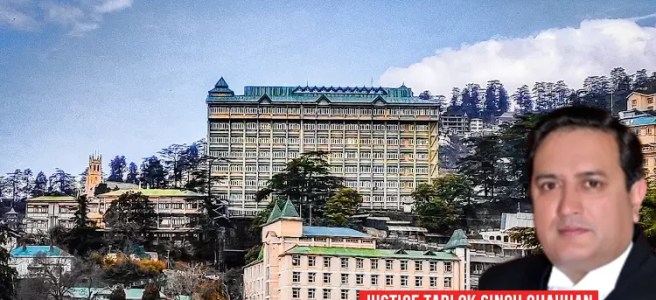
In the Courtroom of Conscience: Reflecting on Justice Tarlok Singh Chauhan
In Shimla, there are two things as certain as the hills themselves: the old town hooter that sounds at ten, and Justice Tarlok Chauhan taking his seat at exactly the same hour. Sharp ten. No dithering, no delay, time, like law, had to be honored. For the bar, this daily certainty meant one thing: if you had a matter before Justice Chauhan, you’d better have your file and your wits in order well before the fog lifted from the Mall Road. Once seated, His Lordship moved through the cause list with a rhythm that was nothing short of orchestral. The courtroom would come alive with movement, petitions called, orders passed, arguments sliced clean with surgical clarity. It wasn’t just speed; it was discipline refined into tempo. Lawyers who fancied a leisurely morning found themselves sprinting through their submissions, their watches forever set to “Justice Chauhan Standard Time.” He didn’t simply hear cases; he breezed through them, but never at the cost of fairness or depth. To witness him in court was to witness the law in motion, not sluggish, not ceremonial, but alive, exacting, and infused with purpose.
Continue reading “In the Courtroom of Conscience: Reflecting on Justice Tarlok Singh Chauhan”The Advocates (Amendment) Bill, 2025: A Threat to Judicial Independence and the Sanctity of the Legal Profession
“The legal profession is not merely an occupation; it is the guardian of justice, the voice of the oppressed, and the first line of defense against tyranny. An independent Bar is the cornerstone of an independent judiciary—compromise it, and you compromise the very foundation of democracy.”
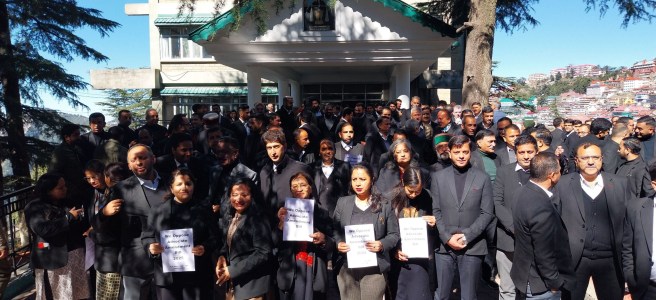
If the Advocates (Amendment) Bill, 2025 had a motto, it would be: “Speak less, comply more, and never question authority.” Wrapped in the language of “reform,” this Bill is less about improving the legal profession and more about taming it. It reads like a playbook for turning fierce, independent advocates into government-approved legal service providers, carefully selected to avoid ruffling any executive feathers. By expanding control over the Bar, criminalizing dissent, and creating a chilling effect on legal activism, the Bill seems designed to ensure that lawyers think twice before taking up cases that challenge the powers that be. In a democracy, advocates are meant to be the watchdogs of justice—but with these amendments, the government appears keen to turn them into obedient house pets, barking only when permitted. The message is clear: fall in line, or risk professional extinction. But history has shown that the legal fraternity does not take kindly to such attempts at subjugation—and the overwhelming resistance to this Bill proves that the fight for an independent Bar is far from over.
Continue reading “The Advocates (Amendment) Bill, 2025: A Threat to Judicial Independence and the Sanctity of the Legal Profession”High Court seeks Rigorous Compliance of sanitation issues: Respect for shared spaces and lessons from Japan
The scene portrayed above is from a Japanese movie, Perfect Days (2023), directed by Wim Wenders. The film portrays the life of a Tokyo toilet cleaner, Hirayama, who finds profound meaning and dignity in his seemingly mundane job. The philosophy of Perfect Days emphasizes finding dignity, meaning, and beauty in tasks, like cleaning toilets, reflecting the profound connection between care for shared spaces and human respect. As essential public services, sanitation and toilets embody this philosophy by upholding public health, equality, and dignity for all. Together, they remind us that even the simplest actions in maintaining hygiene can have transformative societal impacts.
The High Court’s various directives in CWPIL 6 of 2017 and the philosophy of Perfect Days converge on a universal truth: dignity resides in the care we show for our shared spaces and responsibilities. Just as Hirayama’s work elevates public toilets to sanctuaries of care, the court’s insistence on accountability and sustainable practices transforms sanitation into a symbol of collective respect and progress.
Retrospective Regularization and Pay Fixation Benefits: A Win for Forest Guards
In a case that highlights the perils of administrative inefficiency and its impact on the fundamental right to equality, the Himachal Pradesh High Court delivered a landmark judgment in favor of Forest Guards who were left behind in the race for regularization. At the heart of the matter was a seemingly small, yet significant delay in regularizing the petitioners’ services—a delay that cost them the financial and professional benefits their counterparts in the Dharamshala Circle enjoyed. The courtroom battle underscored a critical question: should employees suffer because of administrative lapses beyond their control? The court’s answer was a resounding no.
Continue reading “Retrospective Regularization and Pay Fixation Benefits: A Win for Forest Guards”Protected: “A Fractured Judgment”: A Critique of the Himachal Pradesh High Court’s Judgment on Chief Parliamentary Secretaries
Subscribe to continue reading
Subscribe to get access to the rest of this post and other subscriber-only content.
Inconvienient Judgments that ruffle too many feathers-The case of the silent majority, Judicial Transfers and Sherlock Holmes
Imagine Sherlock Holmes sitting in his Baker Street flat, scratching his head over the enigma of judicial transfers in India. “It’s quite elementary, my dear Watson,” he might say, “except when it’s not. The transfers happen without consent, reasons are shrouded in secrecy, and the silent majority watches as the plot thickens!”
Continue reading “Inconvienient Judgments that ruffle too many feathers-The case of the silent majority, Judicial Transfers and Sherlock Holmes”The Indian Constitution: A Masterpiece of Borrowed Wisdom and Indigenous Innovation
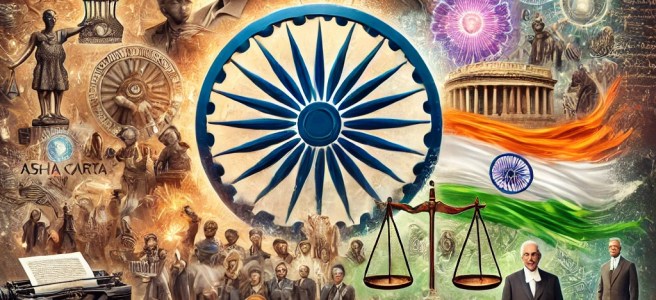
The Indian Constitution is more than a legal framework—it is a testament to the nation’s ability to weave together diverse influences into a coherent whole. It is, in essence, a symphony of ideas, where the wisdom of the ages merges seamlessly with the demands of modernity. As I reflect on this magnificent document, I am reminded of a sculptor chiseling away at a block of marble, revealing a form that is not only beautiful but enduring, adaptable, and deeply reflective of the people it serves.
At its core, the Constitution is a polyglot—a creation born out of a dialogue between India’s ancient civilizational ethos and the great constitutional experiments of the world. It reflects the evolution of human governance, from the flickering flames of Magna Carta to the revolutionary principles of liberty, equality, and fraternity espoused during the French Revolution. Yet, it is uniquely Indian, embodying the spirit of a civilization that has, for millennia, placed a high value on justice, equity, and the welfare of all living beings.
In borrowing from these various traditions, the Indian Constitution becomes more than just a document. It becomes a living organism, growing and evolving as our nation changes. In the words of Justice Felix Frankfurter, “The ultimate touchstone of constitutionality is the Constitution itself and not what we have said about it.” It is in this spirit that we must explore how this monumental text has guided us, not just in times of prosperity, but in moments of profound challenge and transformation.
Continue reading “The Indian Constitution: A Masterpiece of Borrowed Wisdom and Indigenous Innovation”Buy-back policy, HIPA Training, Special Task Force, and other directions by the High Court to Combat Solid Waste Issue
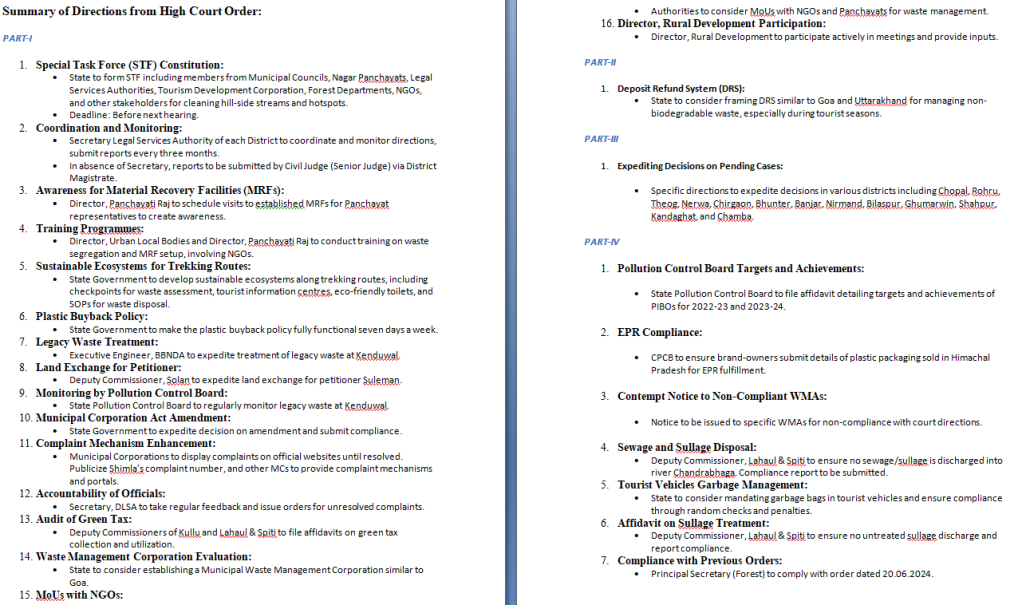
Shimla, August 8, 2024 – The division bench of the High Court of Himachal Pradesh presided over by J. Tarlok Singh Chauhan and J. Sushil Kukreja, in its ongoing commitment to environmental preservation, has issued a series of significant directives aimed at enhancing solid waste management across the state. Building on its earlier orders on March 23, May 9, 2024 and July 18, 2024., the court has now introduced new measures to ensure that these efforts reach the most critical areas and involve every level of society. The court’s new order, dated August 8, 2024, builds on these earlier measures with additional, targeted directives. Let’s dive right in:
Continue reading “Buy-back policy, HIPA Training, Special Task Force, and other directions by the High Court to Combat Solid Waste Issue”High Court Issues Comprehensive Directives to Tackle Solid/Plastic Waste Issue in Himachal Pradesh
Shimla, July 24, 2024 – In a landmark ruling on July 18, 2024, the High Court of Himachal Pradesh, under the astute guidance of Judges J. Tarlok Singh Chauhan and J. Sushil Kukreja, issued an exhaustive order that promises a greener future. This pivotal decision, following the court’s March 23 and May 9, 2024 Orders, addresses critical aspects of compliance and sets forth robust directives for solid waste management. Lets dive right in:

The Proposal to Charge Electricity and Water at Commercial Rates for Homestays: A Critical Examination
In a surprising and controversial move, the Himachal Pradesh government recently announced a proposal to impose commercial rates for electricity and water on homestays. This decision was revealed in various news outlets indicating that a proposal to provide electricity and water facilities in the state’s homestays at commercial rates has been placed before the Cabinet Sub-Committee constituted to amend the Home Stay Rules 2024.
For years, homestays have been a lifeline for middle-class and lower-income families, providing a vital source of supplementary income and contributing to the local economy. However, this new policy threatens to undermine the very foundation of homestays, turning what was once an accessible and inclusive form of tourism into a financially burdensome endeavour. The government argues that aligning utility rates with commercial standards is necessary for regulatory consistency and financial sustainability. However, this rationale fails to consider the unique nature of homestays, which operate on a small scale and offer tourists an authentic, home-like experience rather than a commercial service. The proposal raises critical questions about economic inequality, property rights, and the future of sustainable tourism in Himachal Pradesh. In this blog, we will delve into the multifaceted implications of this proposal, examining how it stands to impact local livelihoods, exacerbate economic disparities, and contradict the very principles of the Incredible India scheme.
Continue reading “The Proposal to Charge Electricity and Water at Commercial Rates for Homestays: A Critical Examination”Gender Bias in Hindu Succession Act: Examining Inequality in Property Rights
In India, inheritance laws vary significantly based on religious affiliations, with Hindus governed by the Hindu Succession Act, 1956 (HSA). A unique aspect of this Act is its differentiation between the intestate succession rights of males and females. Specifically, the intestate succession of a female Hindu depends on the source from which she acquired the property. This article critiques this aspect of the HSA, arguing that it is discriminatory and unconstitutional, and discusses recent legal developments that may bring about significant change.
Continue reading “Gender Bias in Hindu Succession Act: Examining Inequality in Property Rights”