Shimla, July 24, 2024 – In a landmark ruling on July 18, 2024, the High Court of Himachal Pradesh, under the astute guidance of Judges J. Tarlok Singh Chauhan and J. Sushil Kukreja, issued an exhaustive order that promises a greener future. This pivotal decision, following the court’s March 23 and May 9, 2024 Orders, addresses critical aspects of compliance and sets forth robust directives for solid waste management. Lets dive right in:
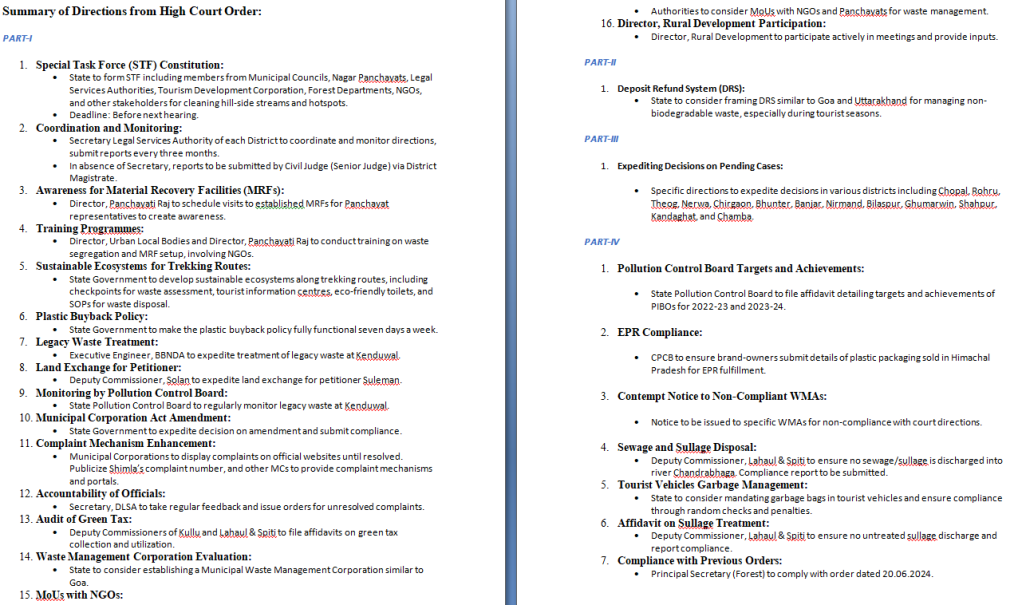
Formation of Special Task Force
The court has directed the state to constitute a Special Task Force (STF) comprising members from Municipal Councils, Nagar Panchayats, Legal Services Authorities, Tourism Development Corporation, Forest Departments, NGOs, and other stakeholders. This task force is expected to focus on cleaning hill-side streams and other environmental hotspots. The STF is to be created before the next hearing, highlighting the urgency of the matter.
Monitoring and Coordination
The Secretary Legal Services Authority in each district will coordinate and monitor the implementation of the court’s directives, including those issued on previous dates. In districts lacking a Secretary, the responsibility falls on the Civil Judge (Senior Judge). Reports on the implementation will be submitted to the court every three months via the District Magistrate, who will address any shortcomings promptly.
Awareness and Training Programs
Recognizing resistance from Panchayats in providing land for Material Recovery Facilities (MRFs), the court has instructed the Director of Panchayati Raj to organize visits for Panchayat representatives to established MRFs. Additionally, the Director of Urban Local Bodies, along with the Director of Panchayati Raj, is to conduct training programs on waste segregation and MRF setup, involving NGOs such as Healing Himalayas and Waste Warriors.
Sustainable Trekking Routes
The court emphasized the development of sustainable ecosystems along popular trekking routes, including Kheerganga, Hamta, Bijli Mahadev, Sach Pass, Beas Kund, Shrikhand Mahadev, Manimahesh Yatra, Churdhar, Triund, and Chansal. The state government is to establish checkpoints for waste assessment, tourist information centres, eco-friendly toilets, and standard operating procedures for adventure companies to ensure proper waste disposal.
Revamping Plastic Buyback Policy
The court noted that the state’s plastic buyback policy is currently non-functional. It directed the government to operationalize this policy seven days a week, providing an incentive for citizens, particularly rag pickers, to collect waste, which could also serve as a source of livelihood.
Legacy Waste Treatment and Pollution Monitoring
The Executive Engineer of BBNDA has been instructed to expedite the treatment of legacy waste at Kenduwal to prevent potential threats to the river Sirsa and nearby human habitations. Additionally, the State Pollution Control Board is tasked with regular monitoring to ensure no waste enters the river.
Enhancing Complaint Mechanisms
The court stressed the need for a robust complaint mechanism within Municipal Corporations. All Municipal Corporations must display complaints on their official websites until resolved, with MC Shimla’s complaint number being widely publicized. Other corporations are to establish similar mechanisms by the next hearing.
Utilization of Green Tax
The court questioned the utilization of green tax collected in District Kullu and areas under Special Area Development Authority (SADA) in Manali, Sirsu, and Koksar. The Deputy Commissioners of Kullu and Lahaul & Spiti must file affidavits detailing the collection and utilization of these funds.
Exploring Waste Management Models
Given Himachal Pradesh’s reliance on tourism, the court suggested evaluating the establishment of a Municipal Waste Management Corporation akin to Goa’s model. It also recommended entering into Memorandums of Understanding (MoUs) with NGOs for setting up waste management centres, citing the successful MoU between Waste Warriors Society and Bir Panchayat.
Director of Rural Development’s Participation
Expressing dissatisfaction with the Director of Rural Development’s lack of engagement, the court directed the Director to actively participate in all future meetings and provide valuable inputs.
Deposit Refund System (DRS)
The court commended the state to consider framing a Deposit Refund System (DRS) similar to those in Goa and Uttarakhand. This system involves a unique QR code with a deposit value for plastic bottles, refundable upon return, incentivizing waste management.
District-Specific Directions
The court issued specific directives to expedite decisions on pending Solid Waste Management (SWM) cases in various districts, including Chopal, Rohru, Theog, Nerwa, Chirgaon, Bhunter, Banjar, Nirmand, Bilaspur, Ghumarwin, Shahpur, Kandaghat, and Chamba.
Pollution Control Board Targets
The State Pollution Control Board is to file an affidavit detailing the targets and achievements of registered producers, importers, and brand owners (PIBOs) for 2022-23 and 2023-24. The Central Pollution Control Board (CPCB) must ensure brand-owners submit plastic packaging details specific to Himachal Pradesh for effective EPR fulfillment.
Compliance and Accountability
The court issued contempt notices to several Waste Management Agencies (WMAs) for non-compliance with its directives. The Deputy Commissioner of Lahaul & Spiti must ensure no sewage or sullage is discharged into the river Chandrabhaga, filing a personal compliance affidavit by the next hearing.
Tourist Garbage Management
The court highlighted the successful model in Sikkim, where tourist vehicles must carry garbage bags for waste collection. It directed similar measures in Himachal Pradesh to promote environmental sustainability.
Pruning of Trees/Silviculture- Compliance Order for Forest Department
The Principal Secretary (Forest) is directed to comply with the court’s previous order dated June, 20 2024 which stated,
“The Forest Department resort to crown thinning, dead pruning, crown reduction, crown lifting, thinning, topping, raising techniques. In such circumstances, the respondents would be well-advised to draw a road-map for High Court of H.P. lopping and pruning the trees by evolving different kinds of techniques, as they may deem fit. ::: Downloaded on – 24/07/2024 17:34:51 :::CIS High Court of H.P. -716. Let the Principal Secretary (Forests) take a call on the subject and report compliance on or before the next date of hearing. 17. We need to make ourselves very clear that in our considered view there is no impediment in this direction as the Hon’ble Supreme Court in the case of T.N. Godavarman Thirumulpad, In Re vs. Union of India and others, (2018)17 SCC 771 has already permitted the State to resort to silviculture felling which in terms of the orders of the Hon’ble Supreme Court is necessary because if no felling is done then regeneration of trees is not as fast as it should be and once the mature trees die after reaching their maximum life span, there will be very few young trees to replace the old trees. Moreover, such provision of lopping is already contained in the working plans.“
Significance of the Order
This comprehensive order by the High Court of Himachal Pradesh underscores the critical need for multi-faceted approaches to environmental conservation and waste management. It brings together various state departments, legal authorities, NGOs, and the community to collaboratively address pressing environmental challenges. The court’s directives aim to establish a sustainable framework that not only preserves the natural beauty of Himachal Pradesh but also ensures the well-being of its residents and the flourishing of its tourism industry.

 LawUmbrella
3 thoughts on “High Court Issues Comprehensive Directives to Tackle Solid/Plastic Waste Issue in Himachal Pradesh”