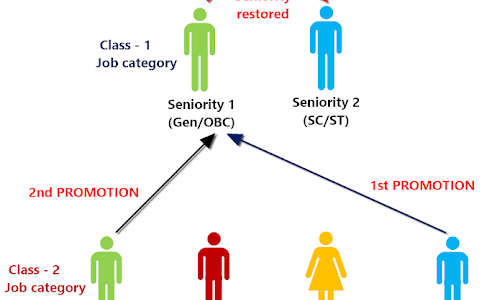
The Hon’ble Supreme Court in the case of Indra Sawhney & Ors. Vs. Union of India & Ors, reported in 1992 Supp.(3) SCC 217, held that Article 16(4) of the Constitution does not permit reservations in the matter of promotion. Thereafter, the Constitution (Seventy-Seventh) Act, 1995 came into force on 17.6.1995. Later on, the Hon’ble Supreme Court in the cases of Union of India & Ors. Vs. Virpal Singh Chauhan & Ors., reported in (1995) 6 SCC 684, Ajit Singh Januja & Ors. (Ajit Singh-I) Vs. State of Punjab & Ors., reported in (1996) 2 SCC 715 and Ajit Singh (II) & Ors. Vs. State of Punjab & ors., reported in (1999) 7 SCC 209, introduced the catch-up rule and held that if the senior general candidate is promoted then he will regain his seniority on promotion post above junior reserved promotes. It was also held that consequential seniority on promotion post is not covered by Article 16(4A).
The Hon’ble Apex Court held that the consequential seniority on promotion post is not covered by Article 16(4-A). Para 27 of the judgment in the case of Union of India & Ors. Vs. Virpal Singh Chauhan is reproduced as under:-
“We are of the opinion that the aforesaid circulars/letters providing for reservation in favour of Scheduled Castes/Scheduled Tribes candidates, rosters and their operation and on the subject of seniority as between general candidates and reserved category candidates, being in the nature of special rules prevail over the general instructions contained in Volume-I of the Indian Railway Establishment Manual including those contained in Paras 306, 309 and 319 et al. Accordingly, we agree with the conclusion of the Tribunal in the order under appeal (Virpal Singh Chauhan) though we may not agree with all the reasons given by the Tribunal. In other words, we may not agree with the view expressed by the Tribunal that a harmonious reading of Clauses (1) and (4) ofArticle 16 should mean that a reserved category candidate promoted earlier than his senior general category candidate in the feeder category shall necessarily be junior in the promoted category to such general category candidate. No such principle may be said to be implicit in the said clauses. But inasmuch the Railway Board’s circulars herein concerned do provide specifically for such a situation and since they cannot be said to be violative of the constitutional provisions, they must prevail and have to be given effect to. It is not brought to our notice that the said instructions are inconsistent in any manner with any of the statutory provisions or statutory rules relevant in this behalf.”
The same view was further taken by the Hon’ble Apex Court in Ajit Singh Juneja-I Vs. State of Punjab & Ors.(supra). Para 16 of the judgment is reproduced as under:-
“We respectfully concur with the view in Union of India vs. Virpal Singh Chauhan that seniority between the reserved category candidates and general candidates in the promoted category shall continue to be governed by their panel position i.e. with reference to their inter se seniority in the lower grade. The rule of reservation gives accelerated promotion, but it does not give the accelerated consequential seniority. If a Scheduled Caste/Scheduled Tribe candidate is promoted earlier because of the rule of reservation/roster and his senior belonging to the general category candidate is promoted later to that higher grade the general category candidate shall regain his seniority over such earlier promoted Scheduled Caste/Tribe candidate. As already pointed out above that when a Scheduled caste/Tribe candidate is promoted earlier by applying the rule of reservation/roster against a post reserved for such Scheduled caste/Tribe candidate, in this process he does not supersede his seniors belonging to the general category. In this process there was no occasion to examine the merit of such Scheduled Caste/Tribe candidate vis-a-vis his seniors belonging to the general category. As such it will be only rational, just and proper to hold that when the general category candidate is promoted later from the lower grade to the higher grade, he will be considered senior to a candidate belonging to the Scheduled Caste/Tribe who had been given accelerated promotion against the post reserved for him. Whenever a question arises for filling up a post reserved for Scheduled Caste/Tribe candidate in a still higher grade then such candidate belonging to Scheduled Caste/Tribe shall be promoted first but when the consideration is in respect of promotion against the general category post in a still higher grade then the general category candidate who has been promoted later shall be considered senior and his case shall be considered first for promotion applying either principle of seniority-cum-merit or merit-cum-seniority. If this rule and procedure is not applied then result will be that majority of the posts in the higher grade shall be held at one stage by persons who have not only entered in service on the basis of reservation and roster but have excluded the general category candidates from being promoted to the posts reserved for general category candidates merely on the ground of their initial accelerated promotions. This will not be consistent with the requirement or the spirit of Article 16(4) or Article 335 of the Constitution.”
(emphasis supplied)
The Constitution Bench of the Hon’ble Apex Court in the case of Ajit Singh Juneja II Vs. State of Punjab & Ors. (supra) further approved the ‘catch-up’ rule and followed its earlier judgments given in Virpal Singh Chauhan and Ajit Singh-I’s case(supra). Paras 81 of the judgment is reproduced as under:-
“81.As accepted in Virpal(see SCC at p.702) and Ajit Singh (see SCC at p.729), we hold that in case any senior general candidate at Level 2 (Assistant) reaches Level 3 (Superintendent Grade II) before the reserved candidate (roster point promotee) at Level 3 goes further up to Level 4 in that case the seniority at Level 3 has to be modified by placing such a general candidate above the roster promotee, reflecting their inter se seniority at Level 2. Further promotion to Level 4 must be on the basis of such a modified seniority at Level 3, namely, that the senior general candidate of Level 2 will remain senior also at Level 3 to the reserved candidate, even if the latter had reached Level 3 earlier and remained there when the senior general candidate reached that Level 3.In cases where the reserved candidate has gone upto Level 4 ignoring the seniority of the senior general candidate at Level 3, seniority at Level 4 has to be refixed (when the senior general candidate is promoted to Level 4) on the basis of when the time of reserved candidate for promotion to Level 4 would have come, if the case of the senior general candidates was considered at Level 3 in due time. To the above extent, we accept the first part of the contention of the learned counsel for the general candidates. Such a procedure in our view will properly balance the rights of the reserved candidates and the fundamental rights guaranteed underArticle 16(1) to the general candidates”.
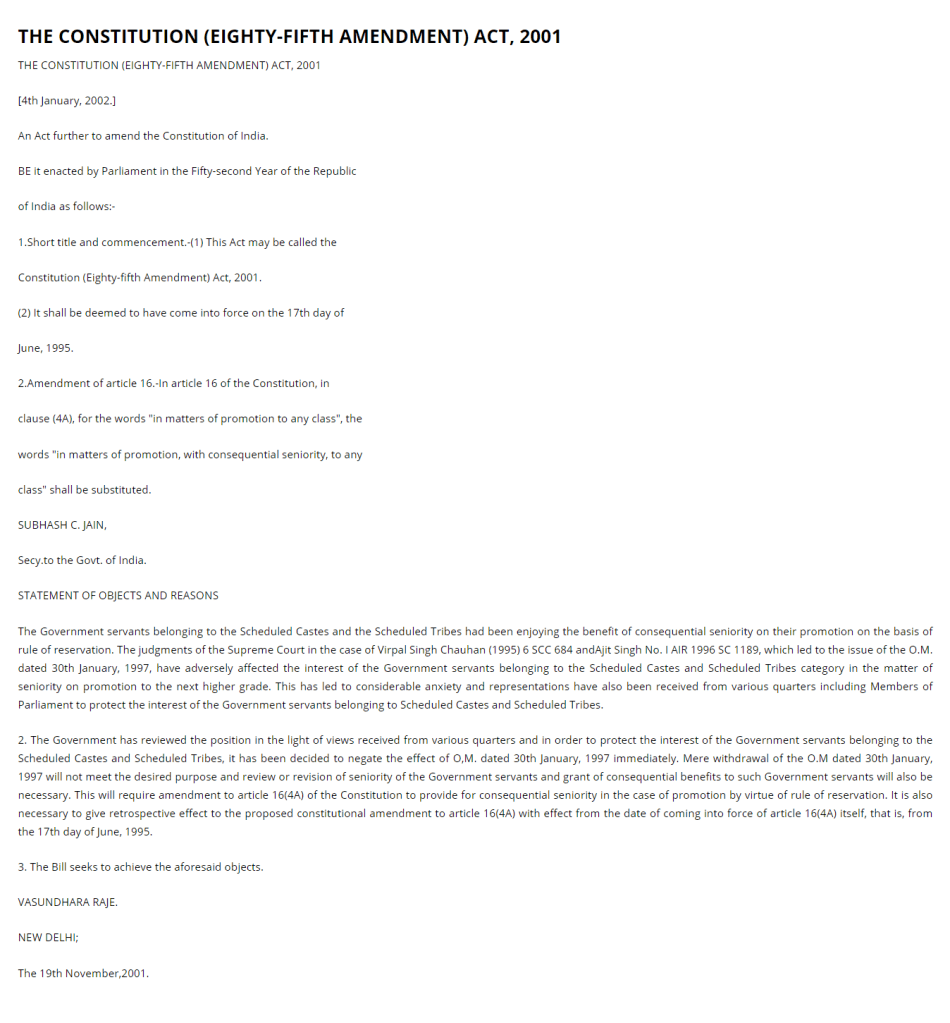
85th and 117th AMENDMENT:- In order to remove this inconsistency, to dilute and repeal the ‘catch up principle’, parliament of India again amended the constitution, where the term ‘consequential seniority’ was introduced in Article 16(4)A. In the Object and Reasons of the 85th Amendment parliament of India agreed and accepted that
“ The judgements of Supreme Court in the case of Union of India Vs Virpal Singh Chauhan and Ajit Singh Janjhua Vs State of Punjab, which lead to the issuance of OM dated 30/01/1997, have adversely affected the interest of Government Servants belonging to Schedule castes and Schedule Tribes category in the matter of seniority on promotion to the next higher grade.”
Hence parliament made sure that along with promotions consequential seniority is also given and catch up principle is repealed.
The constitutionality of 77th, 81st, 82nd and 85th Amendments were challenged in M.Nagraj case where the petitioners contended that consequential seniority cannot be given to the members of SCs and STs once the accelerated promotion is granted. Even after upholding the constitutional validity of all the amendments Hon’ble Court was of the point of view –
“ Para 123:- However, in this case, as stated above, the main issue concerns the extent of reservation. In this regard the State concerned will have to show in each case the existence of compelling reasons, namely, backwardness, inadequacy of representation and over all administrative efficiency before making provision for reservation. As stated above, the impugned provision is an enabling provision. The state is not bound to make reservation for SCs/STs in matter of promotion however if they wish to exercise their discretion and make such provision, the state has to collect quantifiable date showing backwardness of the class and inadequacy of the representation of that class in public employment in addition to compliance with article 335.”
In sustaining the validity of Articles 16 (4A) and 16 (4B) against a challenge
of violating the basic structure, Nagaraj applied the test of width and the test of identity. The Constitution Bench ruled that the catch-up rule and consequential seniority are not constitutional requirements. They were held not to be implicit in clauses (1) to (4) of Article 16. Nagaraj held that they are not constitutional limitations or principles but are concepts derived from service jurisprudence. Hence, neither the obliteration of those concepts nor their insertion would violate the equality code contained in Articles 14, 15 and 16. The principle postulated in Nagaraj is that consequential seniority is a concept purely based in service jurisprudence. The incorporation of consequential seniority would hence not violate the constitutional mandate of equality. This being the true constitutional position, the protection of consequential seniority as an incident of promotion does not require the application of the creamy layer test. Articles 16 (4A) and 16 (4B) were held to not obliterate any of the constitutional limitations and to fulfil the width test.
Latest in the line of the cases is a Constitutional Judge Bench decision in Jarnail Singh v Lacchmi Narain Gupta which clarified certain positions of the above cases, this case does not deal with “cath-up” principle directly but has some observations regarding its application, here it was expressly rejected that “a member of an SC or ST who reaches a higher post no longer has a taint of untouchability or backwardness”. It was held that:
“Insofar as the State having to show quantifiable data as far as backwardness of the class is concerned, we are afraid that we must reject Shri Shanti Bhushan’s argument. The reference to ―class‖ is to the Scheduled Castes and the Scheduled Tribes, and their inadequacy of representation in public employment. It is clear, therefore, that Nagaraj (supra) has, in unmistakable terms, stated that the State has to collect quantifiable data showing backwardness of the Scheduled Castes and the Scheduled Tribes. We are afraid that this portion of the judgment is directly contrary to the nine-Judge Bench in Indra Sawhney (1) (supra). (paragraph 14)”
The author of the judgment Nariman J. went on to hold that even though Indira Sawhney had not expressly chosen to apply the creamy layer principle to Scheduled Castes and Scheduled Tribes, it had always been clear that the principle was a facet of constitutional equality. Nariman J. relied upon N.M. Thomas for this principle, relying upon some observations in Krishna Iyer J.’s concurring opinion, to note that:
The whole object of reservation is to see that backward classes of citizens move forward so that they may march hand in hand with other citizens of India on an equal basis. This will not be possible if only the creamy layer within that class bag all the coveted jobs in the public sector and perpetuate themselves, leaving the rest of the class as backward as they always were. This being the case, it is clear that when a Court applies the creamy layer principle to Scheduled Castes and Scheduled Tribes, it does not in any manner tinker with the Presidential List under Articles 341 or 342 of the Constitution of India. The caste or group or sub-group named in the said List continues exactly as before. It is only those persons within that group or sub-group, who have come out of untouchability or backwardness by virtue of belonging to the creamy layer, who are excluded from the benefit of reservation. Even these persons who are contained within the group or sub-group in the Presidential Lists continue to be within those Lists. It is only when it comes to the application of the reservation principle under Articles 14 and 16 that the creamy layer within that sub-group is not given the benefit of such reservation. (paragaraph 15)
Importantly, Nariman J then went on to hold to “exclude” the creamy layer from reservations (paragraph 16). Further the decision in Jarnail rejected the submission that a member of an SC or ST who reaches a higher post no longer has a taint of untouchability or backwardness. The Constitution Bench declined to accept the submission on the ground that it related to the validity of Article 16 (4A) and held thus:
“34…We may hasten to add that Shri Dwivedi’s argument cannot be confused with the concept of “creamy layer” which, as has been pointed out by us hereinabove, applies to persons within the Scheduled Castes or the Scheduled Tribes who no longer require reservation, as opposed to posts beyond the entry stage, which may be occupied by members of the Scheduled Castes or the Scheduled Tribes.
Important dates for the application of the Catch Up Rule
- The decision in Virpal Singh held that the catch-up rule would be applied only from 10 February 1995 which was the date of the judgment in Sabharwal;
- The decision in Ajit Singh II specifically protected the promotions which were granted before 1 March 1996 without following the catch-up rule; and
- In Badappanavar, promotions of reserved candidates based on consequential seniority which took place before 1 March 1996 were specifically protected.
- Since promotions granted prior to 1 March 1996 were protected, legislature passed an enactment to protect consequential seniority known as ‘The Reservation Act 2018. The object of the Reservation Act 2018 was to accord consequential seniority to promotes against roster points.

 LawUmbrella
in feeder cadre seniority as JDM I placed at Sr. no. 52 &my Jr. Azad sing at sr. no. 68 and after promotion of D/m against S C quota his Sr. no.76 & I stand at Sr. no 61, their after he was promoted ,time& again by clear-cut violated of all norms /. the SC judgment 16.9.1999 Ajit-singh& other i.e HDM dt.13.9.82/CHD on 15.1.95 &Retd. on2005. But I was promoted later i.e HDM dt.13.3.2002/ CHD dt.9.9.2010 & CDM 6.2012,Retd.on 28.2.2013. After the above judgment,Govt. Haryana had issued Inst. no. 1/15/2003/2-PR/FD dated.27.11.2003 for stepping-up pay of sr. Genl. candidates at par with Jr. s c candidates,the same has been adopted by the DHBVN,UHBVN / HVPN & ,Ld LR,HVPN had also Issued his valuable advice vide memo no.05/LR4(127) dt.13.04.2007.& I applied for stepping-up my pay at par with Jr. sh. Azad singh (s c), the SE /HR issued seniority certificate vide memo no.42/GA/43/DRG .dt.19.05.2008,but pay was not stepped up, imposed Instruction 16.3.2006 /catch up rule even then nos of my other counter parts, selected in the list have taken, stepping up pay with same Jr. counter part Azadsingh (s c) CHD REtd. Now quashed of inst. 16.3.2006 by Pb.& Hry. High-Court in CWP-17280/2011 &Govt. issued Inst.22/132/2008-1/GSiii dt.20.2.2012/csto govt.Dt.23.5.2013 i again requested,SE /HR issued o/o 338 dt 30.5.2013.& A.o pay fixation verified pay notionally as per Govt. Inst.& cheque was handed over on 1.8.2013,but payment was stoped &passed wrong O/o352 dt. with hold deem date of HDM/CHD not cough on post of HDM/CHD and after repeated requests case has been Sent to Ld. LR & get views by hiding facts and the DIr./op DHBVN inquired case on my request From Chief Financial Officer,DHBVN Hisar,he reoprtd that the case may be sent to Ld. Lr for his advice with the facts on mariet. But HR/ officials are in try to missleadding the Ld LR to rejcet on catch up principle.In judgment of CWP-25512/2012 high court had ordered to withdrawn accelerated senority sice 2006 &Govt. has issued inst.no22/183/2015gs-iidt.3.2.2016 for sought fig. of revesion 16.3.2006 to date. PL. Calerify the matter.
LikeLike
my case for stepping -up pay at par with my Jr. counter part sh.Azad singh(SC) quota posted as JDM in HSEB now DHBVN pending since 2008 &my other Genl. category candidates selected as JDM in same list have granted stepping up his pay with same Jr. counter part Azad singh(SC) in 2009, But my cheque was stopped with paely of catch up Rule,now Pb.&Hary. High-Court quashed inst.2006 &withdrawn accelerated seniority granted to SC candidates
Particularsas:-Jr. Azad singh (SC)JDM 17.1.1977/DM19.3.1979/HDM13.9.1982/CHD15.1.1995 &Retd.on 2005.( promoted aganistSC Quota by Giving un- due benefit /violated all norms/,Judgment of the SC India 16.9.1999 Ajit singh& other
Sr.omparkash (Genl.) JDM20.12.76/DM17.9.1979/HDM13.3.2002/CHD9.92010 &Retd. on28.2.2013.stepping up case pending &catch-up rule imposed wrongly earlier SC more deliberated catch Rule Feb,12,2017.
LikeLike
I am employ Retd. from DHBVN as CDM in Feb.2013 & Stepping up pay case were pending since 2008,with my Jr. counter part Azad singh (SC) CHD REtd.in 2005. nos of other Genl. counter parts have granted his pay with sh,Azad singh (SC). in 2009. But i harasshed badly on catch-up Rule where as Pb.& Hry. HIGH COURT has with drawn accelerated seniority .
LikeLike
PL .clear CATCH-UP Rule on which my stepping-up of pay arrears payment stopped, Jr. SC candidates gifted promotion time& again i.e 4th,5th level by violated all norms.
LikeLike
pl. find CATCH_UP RULE instruction, after 2013 by Govt.Hry. so i can able to take arrears payment stopped for catch- up point.
LikeLike
my stepping up pay arrears stopped,catch-up Rule Pl. find latest instructions of Hry. Govt.to clear issue.
LikeLike
i in need of instruction/judgment to clear catch-up rule,my Jr.SC candidates have promoted violated all norms as well as judgement of the The hon’able SC of India ,Ajit singh &other dated16.9.1999
LikeLike
sir have you filed a writ under article 226 for wrongful denial of benefits ?
if similarly situated persons are granted benefit and you have been denied the same, than there is a violation of article 14 (Right to Equality).
Secondly catch up principle is for the benefit of “general candidates “, if your junior was promoted by way of accelerated promotions (being an SC) under the policy, then if you catch of to him on any promotional level or post , you would be considered senior to him for all intent and purpose (benefits). and if the same is denied to you then there is a violation of your fundamental right under Article 16 (1)
i need to have more clarity with regards to the facts of your case ,, if you wish you can send me the impugned order and the petition on khannadeven@gmail.com , i can go through it and advise you accordingly.
LikeLike
Sir, There are 3 post of CDM in DHBVN, & my Jr.s c candi., after my objection Force fully promoted 0n 5th level as CDM,I
Jan.1,2006 &I ignored for promotion. On my Request in 20010 the than MD Sudhir Rajpal IAS gone through facts& the promotion of” SH. Vijender singh is wrong & in contrary of the Nigam instruction. ,pay of the official worked out from CHD to CDM ,to give me. 3 reminders were issued for,but after transfer of MD case as filed with wrong facts. may i able to get the same as i had worked as CDM max.period in addation to my present duty(HDM). I retd. as CDM in ,Feb. 2013 & continously Requested For the same.
LikeLike
sir, My Jr. sc candidate promoted 5th level as CDM in 1 jan. 2006 by violated Judgment of Hon’ble S C Dt. 16. 9 1999. But on my appeal MD DHBVN decided as”that promotion is wrong & in contrary of instruction of the Nigam,Pay of the official worked-out, after issue of 3 reminders,case Filed on falls facts, may I able to get benefits from 2006,being i have worked as CDM post max. in addition to my present duty please.
LikeLike
sir, I am sending copy of both cases i.e payment cheque of arrears stepping-up pay stopped as perur valuable advice on 5/10/17 and the promotion of my other Jr. vijendr singh on 5th step as CDM on I Jan 2006, commuted wrong, for suggest me wright way ,What i do?
LikeLike
Some ambiguities regarding catch up rule still persist. In a service there are seven grades. For example in the “X” service there are A.B.C.D,E,F,G grades. ‘A’ is the base level grade and the posts in this grade are filled up by direct recruitment of which 40% are reserved for SCs and STs under the roster rules. Except grade ‘A’, posts in the other grades are promotional posts required to be filled up by selection from the feeder grades. To fill up the posts in grade ‘B’ selection of suitable candidates shall be made from incumbents in grade’A’. Similarly for grade ‘C’ incumbents will be selected from the feeder grade ‘B’ and so on. At the time of promotion, if junior reserve category candidate from grade”A’ is promoted earlier than his senior General candidate to Grade ‘B’, and the senior General candidate is later promoted to grade’ B’ he will regain his seniority. But when promotion is given from grade ‘B’ to grade ‘C’ or grade ‘C’ to grade ‘D’ will the same procedure be followed ? Or after the first promotion in the initial grade there shall be no further promotion on roster basis? Please clarify on the basis of the judgments of the supreme court.
LikeLike
Respected Sir,
In the DHBVNL, Vidyut Nagar, Hisar (Haryana), there is a fraud of crores of rupees as, in the name of stepping up of pay, excess salaries / pensionary benefits are being disbursed to the ineligible employees after mis-using the post and powers. In the guise of refixing the seniorities, only the initial appointment seniority/ First entrant’s seniority are being compared and not the law laid down by Hon’ble Supreme Court in Virpal Singh Chauhan, Ajit Singh Janjua-I, Askhil Bhartiya Soshit Karamchari Sangh and Ajit Singh Janjua-II. Self made Catch up rule is being implemented. Besides, prospectivity of R.K.Sabharwal and Ajit Singh Janjua-I is also not being implemented deliberately in the DHBVNL. Forcibly, I was retained at Level-III (P.A.) from 14.9.92 to 31.3.2015 (More than 22 year’s) and not promoted as PS & Sr.P.S. It is very difficult for the SC employees to get justice as, only 1% are fair on this issue. The financial scam of crores of rupees should have been enquired and excess salaries / pensionary benefits should have been recovered from all in the DHBVN but it is not possible as, the justice is meant for powerful only.
LikeLike
Sir,I have qualified Railway group B 70%quota exam and &unreserve post were 13 and SC quota was 1 but but SC condidates promoted at 2 seats one was as SC & other promoted against general quota.I could not promote . What is rule.
LikeLike