Straying from the Law to Cage Compassion – Supreme Court’s diktat on street dogs of national capital

When the Supreme Court’s August 2025 order on street dogs dropped, it landed with all the subtlety of a bulldozer in a butterfly garden. In one sweep, the Bench declared that every single community dog in Delhi-NCR must be rounded up, carted off to shelters, and never set paw on its old street again dismissing, without ceremony, any voice of dissent from animal welfare groups. The problem? India already has a law for this, the Prevention of Cruelty to Animals Act and the Animal Birth Control Rules, 2023 and that law says precisely the opposite: sterilise, vaccinate, and return them to their home turf, not exile them indefinitely. In the courtroom drama of “public safety versus compassion,” the scriptwriter here seems to have thrown the statute book out of the window.

Continue reading “Straying from the Law to Cage Compassion – Supreme Court’s diktat on street dogs of national capital”

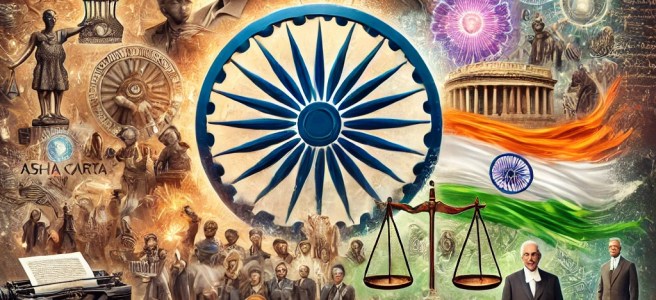
The Indian Constitution: A Masterpiece of Borrowed Wisdom and Indigenous Innovation

The Indian Constitution is more than a legal framework—it is a testament to the nation’s ability to weave together diverse influences into a coherent whole. It is, in essence, a symphony of ideas, where the wisdom of the ages merges seamlessly with the demands of modernity. As I reflect on this magnificent document, I am reminded of a sculptor chiseling away at a block of marble, revealing a form that is not only beautiful but enduring, adaptable, and deeply reflective of the people it serves.

At its core, the Constitution is a polyglot—a creation born out of a dialogue between India’s ancient civilizational ethos and the great constitutional experiments of the world. It reflects the evolution of human governance, from the flickering flames of Magna Carta to the revolutionary principles of liberty, equality, and fraternity espoused during the French Revolution. Yet, it is uniquely Indian, embodying the spirit of a civilization that has, for millennia, placed a high value on justice, equity, and the welfare of all living beings.

In borrowing from these various traditions, the Indian Constitution becomes more than just a document. It becomes a living organism, growing and evolving as our nation changes. In the words of Justice Felix Frankfurter, “The ultimate touchstone of constitutionality is the Constitution itself and not what we have said about it.” It is in this spirit that we must explore how this monumental text has guided us, not just in times of prosperity, but in moments of profound challenge and transformation.

Continue reading “The Indian Constitution: A Masterpiece of Borrowed Wisdom and Indigenous Innovation”

A Scrutiny of Administrative Decisions: The Tale of Sub-Tehsil Bagshad versus Tattapani

Introduction:

In the intricate fabric of administrative law and governance, the creation of a Sub-Tehsil is primarily a matter of administrative convenience aimed at the efficient delivery of governmental services to the populace. However, when such administrative actions collide with public interest and perceived notions of fairness, they demand meticulous scrutiny. This article delves into a case where the creation of Sub-Tehsil Bagshad versus Tattapani in District Mandi raised complex questions about administrative decisions, public interest, and the scope of judicial review.

Continue reading “A Scrutiny of Administrative Decisions: The Tale of Sub-Tehsil Bagshad versus Tattapani”

Academic Merit of the candidate must also reckon the services rendered for the Common Good

In view of ensuring  ‘Right to Health’, adequate medical facilities and an adequate number of doctors in the rural areas, an important order has been passed by the Patna High Court in the current circumstances of  a ‘Pandemic’. The Order is in line with judiciaries endeavor to fulfill its obligation towards securing social justice for the poor and especially for the people living in rural parts of our country.

Continue reading “Academic Merit of the candidate must also reckon the services rendered for the Common Good”