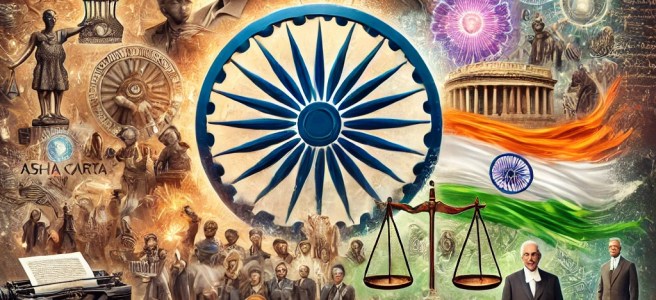
The Indian Constitution is more than a legal framework—it is a testament to the nation’s ability to weave together diverse influences into a coherent whole. It is, in essence, a symphony of ideas, where the wisdom of the ages merges seamlessly with the demands of modernity. As I reflect on this magnificent document, I am reminded of a sculptor chiseling away at a block of marble, revealing a form that is not only beautiful but enduring, adaptable, and deeply reflective of the people it serves.
At its core, the Constitution is a polyglot—a creation born out of a dialogue between India’s ancient civilizational ethos and the great constitutional experiments of the world. It reflects the evolution of human governance, from the flickering flames of Magna Carta to the revolutionary principles of liberty, equality, and fraternity espoused during the French Revolution. Yet, it is uniquely Indian, embodying the spirit of a civilization that has, for millennia, placed a high value on justice, equity, and the welfare of all living beings.
In borrowing from these various traditions, the Indian Constitution becomes more than just a document. It becomes a living organism, growing and evolving as our nation changes. In the words of Justice Felix Frankfurter, “The ultimate touchstone of constitutionality is the Constitution itself and not what we have said about it.” It is in this spirit that we must explore how this monumental text has guided us, not just in times of prosperity, but in moments of profound challenge and transformation.
Continue reading “The Indian Constitution: A Masterpiece of Borrowed Wisdom and Indigenous Innovation” LawUmbrella