The Indian Constitution, a living document, embodies the ethos of democracy and social justice. Its various provisions are designed to ensure not just legal equality but also to promote substantive equality among its citizens. Article 16 stands as a cornerstone in this endeavor, focusing on equality of opportunity in employment. This article presents an intricate balance between the principle of non-discrimination (Article 16(1)) and affirmative action (Article 16(4)), showcasing the Indian state’s commitment to creating a level playing field for all, especially the oppressed classes.
Continue reading “Article 16 of the Indian Constitution – Equality and the Evolution of Reservation Policies”Tag: consequential seniority
‘Catch-Up’ principle and ‘Consequential Seniority’ in Promotion
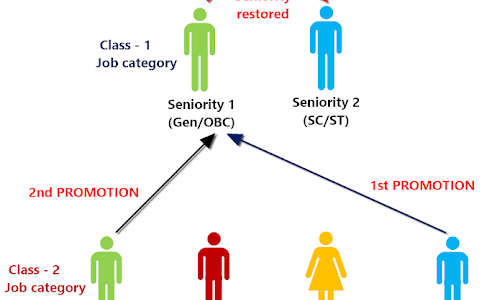
The Hon’ble Supreme Court in the case of Indra Sawhney & Ors. Vs. Union of India & Ors, reported in 1992 Supp.(3) SCC 217, held that Article 16(4) of the Constitution does not permit reservations in the matter of promotion. Thereafter, the Constitution (Seventy-Seventh) Act, 1995 came into force on 17.6.1995. Later on, the Hon’ble Supreme Court in the cases of Union of India & Ors. Vs. Virpal Singh Chauhan & Ors., reported in (1995) 6 SCC 684, Ajit Singh Januja & Ors. (Ajit Singh-I) Vs. State of Punjab & Ors., reported in (1996) 2 SCC 715 and Ajit Singh (II) & Ors. Vs. State of Punjab & ors., reported in (1999) 7 SCC 209, introduced the catch-up rule and held that if the senior general candidate is promoted then he will regain his seniority on promotion post above junior reserved promotes. It was also held that consequential seniority on promotion post is not covered by Article 16(4A).
Continue reading “‘Catch-Up’ principle and ‘Consequential Seniority’ in Promotion” LawUmbrella