Female Intestate Succession under Hindu Law: Analyzing its Constitutionality

This is a guest post by Ayushi Singhal

Under the present legal system of India, people from different religions are governed by their own personal laws in matters of inheritance, marriage, separation, guardianship etc. In this regard, the succession in Hindus is governed by the Hindu Succession Act, 1956 (‘HSA’). Continue reading “Female Intestate Succession under Hindu Law: Analyzing its Constitutionality”

Allocation of marks for interview test (service law)

There cannot be any rule of thumb regarding the precise weight to be given to Interview and that it must vary from service to service according to the requirements of the service, the minimum qualifications prescribed, the age group from which the selection is to be made, the body to which the task of holding the interview test is proposed to be entrusted and a host of other factors. Continue reading “Allocation of marks for interview test (service law)”

Law regarding Re-evaluation of Answer Scripts (Civil services)

Introduction: The question regarding the ability of a court to mandate the re-evaluation of examination papers in the absence of a specific statutory provision is a matter of great legal significance. The Supreme Court of India has consistently maintained that re-evaluation of examination papers is not a right that candidates can demand unless there is an explicit provision in the relevant rules or statutes. The jurisprudence pertaining to the re-evaluation of answer scripts in India is marked by a strong reluctance to interfere in the absence of statutory provisions. Nevertheless, the Supreme Court has made exceptions in situations where there are clear errors in evaluation or when statutory rights, such as those enshrined in the Right to Information (RTI) Act, are implicated. Together, these judgments underscore the importance of maintaining a balanced approach that respects the autonomy of educational institutions while ensuring fairness and accuracy in the evaluation process.

Continue reading “Law regarding Re-evaluation of Answer Scripts (Civil services)”

‘Catch-Up’ principle and ‘Consequential Seniority’ in Promotion

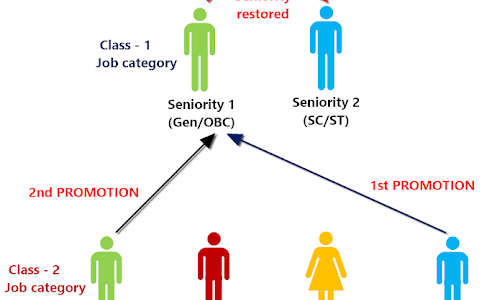
The Hon’ble Supreme Court in the case of Indra Sawhney & Ors. Vs. Union of India & Ors, reported in 1992 Supp.(3) SCC 217, held that Article 16(4) of the Constitution does not permit reservations in the matter of promotion. Thereafter, the Constitution (Seventy-Seventh) Act, 1995 came into force on 17.6.1995. Later on, the Hon’ble Supreme Court in the cases of Union of India & Ors. Vs. Virpal Singh Chauhan & Ors., reported in (1995) 6 SCC 684, Ajit Singh Januja & Ors. (Ajit Singh-I) Vs. State of Punjab & Ors., reported in (1996) 2 SCC 715 and Ajit Singh (II) & Ors. Vs. State of Punjab & ors., reported in (1999) 7 SCC 209, introduced the catch-up rule and held that if the senior general candidate is promoted then he will regain his seniority on promotion post above junior reserved promotes. It was also held that consequential seniority on promotion post is not covered by Article 16(4A).

Continue reading “‘Catch-Up’ principle and ‘Consequential Seniority’ in Promotion”

Prevention of Mechanical Arrests, Due Process to be Complied With


“No arrest should be made only because the offence is cognizable and non- bailable and therefore, lawful for the police officers to do so”.

Abuse of power to arrest by the police has been significantly curbed by the Supreme Court in Arnesh Kumar v. State Bihar, where the court highlighted the problems related to hasty arrests by the police. Continue reading “Prevention of Mechanical Arrests, Due Process to be Complied With”

What is the “State”? – I: Article 12 and Constitutional Obligations

When we think of a Bill of Rights, there are two structural questions that we must answer before we even get to analysing its substantive content. Against whom are the rights enforceable – i.e., which parties are subject to the obligations that the rights impose. And who is entitled to enforce the rights – a question that often (but by no means always) translates into the question of which parties do the rights protect. Both these questions have been controversial. Evidently, individuals are beneficiaries of fundamental rights. But what about corporations? Continue reading “What is the “State”? – I: Article 12 and Constitutional Obligations”

What is the State – IV: Agency/Instrumentality as a Function of State Control

In Ajay Hasia, the question was whether the Regional Engineering College of Srinagar was “State” within the meaning of Article 12. The College had been established, and its administration was carried on, by a Society that was registered under the J&K Societies Act. Consequently, the first argument of the Society was that it had not been set up by the government under a statute, and so could not come within the meaning of Article 12. Unsurprisingly, following R.D. Shetty, the Court rejected this contention. It cited R.D. Shetty copiously, and declared itself to be following its decision. The impact, however, was rather different.
Continue reading “What is the State – IV: Agency/Instrumentality as a Function of State Control”