The Proposal to Charge Electricity and Water at Commercial Rates for Homestays: A Critical Examination

In a surprising and controversial move, the Himachal Pradesh government recently announced a proposal to impose commercial rates for electricity and water on homestays. This decision was revealed in various news outlets indicating that a proposal to provide electricity and water facilities in the state’s homestays at commercial rates has been placed before the Cabinet Sub-Committee constituted to amend the Home Stay Rules 2024.

For years, homestays have been a lifeline for middle-class and lower-income families, providing a vital source of supplementary income and contributing to the local economy. However, this new policy threatens to undermine the very foundation of homestays, turning what was once an accessible and inclusive form of tourism into a financially burdensome endeavour. The government argues that aligning utility rates with commercial standards is necessary for regulatory consistency and financial sustainability. However, this rationale fails to consider the unique nature of homestays, which operate on a small scale and offer tourists an authentic, home-like experience rather than a commercial service. The proposal raises critical questions about economic inequality, property rights, and the future of sustainable tourism in Himachal Pradesh. In this blog, we will delve into the multifaceted implications of this proposal, examining how it stands to impact local livelihoods, exacerbate economic disparities, and contradict the very principles of the Incredible India scheme.

Continue reading “The Proposal to Charge Electricity and Water at Commercial Rates for Homestays: A Critical Examination”

Gender Bias in Hindu Succession Act: Examining Inequality in Property Rights

In India, inheritance laws vary significantly based on religious affiliations, with Hindus governed by the Hindu Succession Act, 1956 (HSA). A unique aspect of this Act is its differentiation between the intestate succession rights of males and females. Specifically, the intestate succession of a female Hindu depends on the source from which she acquired the property. This article critiques this aspect of the HSA, arguing that it is discriminatory and unconstitutional, and discusses recent legal developments that may bring about significant change.

Continue reading “Gender Bias in Hindu Succession Act: Examining Inequality in Property Rights”

Consumer Protection, Medical Negligence and Compensation- Supreme Court Verdict

Imagine undergoing what should be a routine surgical procedure, only to find yourself in a prolonged battle against pain and suffering caused by the very professionals entrusted with your care. This was the harsh reality faced by Jyoti Devi, whose simple appendectomy spiralled into a nightmare of continuous agony and medical mishandling. The Supreme Court of India speaking through Justice Sanjay Karol in Jyoti Devi vs Suket Hospital & Ors. not only provided her long-overdue justice but also reinforced critical principles of medical negligence and consumer protection in India. This case shines a spotlight on the importance of holding healthcare providers accountable and ensuring that victims receive fair and adequate compensation for their suffering. Let’s dive right in!

Continue reading “Consumer Protection, Medical Negligence and Compensation- Supreme Court Verdict”

Counting of Contract Service for Seniority and Benefits: An Analysis of Taj Mohammad Case

The case of Taj Mohammad vs. The State of Himachal Pradesh, adjudicated by the High Court of Himachal Pradesh, marks a significant moment in the interpretation of service rules within the State. The case intricately examines the implications of counting contractual service for seniority and other benefits in government employment, a topic of immense relevance to thousands of public sector employees. The case confirms the vital rights of public sector employees transitioning from contractual to regular appointments. The Court’s decision maintained that the entire service period, including the contractual stage, should count towards seniority and related benefits. The judgment aligns with the principles of fairness and equality set by the Indian Constitution and emphasizes that regularization of employment should retrospectively recognize the entirety of an employee’s service. This case is of substantial significance for its implications on seniority and regularization of contractual employees, in government departments.

Continue reading “Counting of Contract Service for Seniority and Benefits: An Analysis of Taj Mohammad Case”

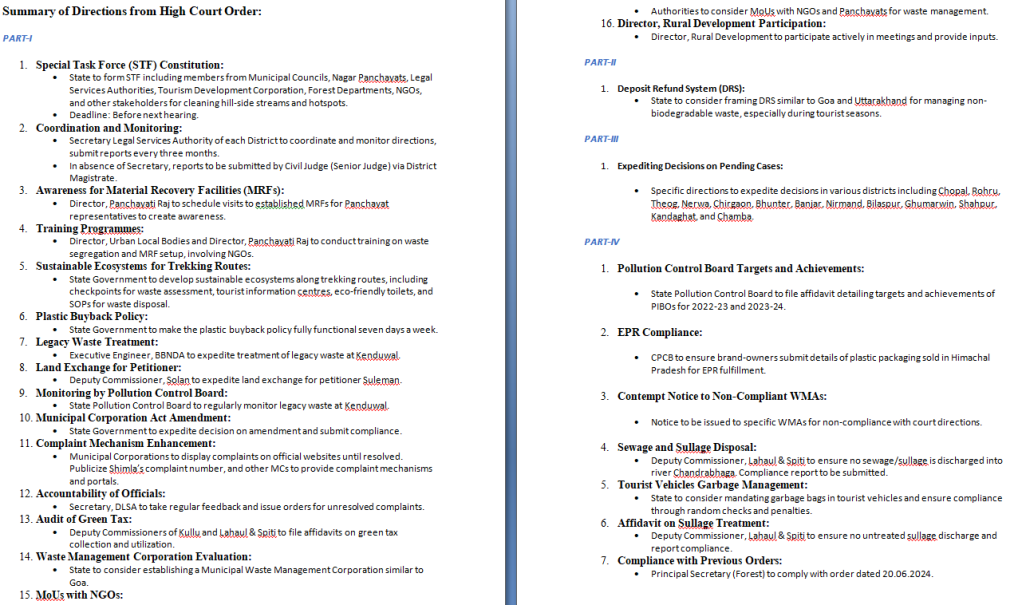
State’s Compliance and Waste Management Directives by High Court in Suleman Vs UOI

In a significant decision dated May 9, 2024, the High Court of Himachal Pradesh, presided over by Judges J. Tarlok Singh Chauhan and J. Sushil Kukreja, delivered a comprehensive order addressing multiple matters concerning the compliance with the earlier order, examining the Action taken report of Municipal Corporation Shimla, and issuing directions in furtherance of its March 23 Order for solid waste management. This article deals with the above three aspects of the order in three Parts.

Continue reading “State’s Compliance and Waste Management Directives by High Court in Suleman Vs UOI”

The Aquatic Arteries of the Himalayas: Judicial intervention to preserve rivers from a grave threat of sewage treatment plants.

Pristine peaks of the Himalayas in Himachal Pradesh are renowned for their breathtaking landscapes and vibrant ecosystems. However, beneath the serene surface, a crisis brews in its veins—the rivers and streams that carve through this mountainous terrain are under siege. Pollution, unchecked and unbridled, threatens not only the rich wildlife that depends on these waters but also the communities for whom these rivers are lifelines. The purity of these waters is integral to the ecological balance and cultural heritage of not only this region but also the rest of the country as the Himalayas provide water to most of the parts of the Indian sub-continent. The water bodies face peril from industrial discharge, inadequate waste management, and faltering sewage treatments.

Continue reading “The Aquatic Arteries of the Himalayas: Judicial intervention to preserve rivers from a grave threat of sewage treatment plants.”

State’s Duty to Honor Pension Commitments | Suneet Singh Jaryal Case

In a recent decision, the High Court of Himachal Pradesh adjudicated the case of Suneet Singh Jaryal v. State of Himachal Pradesh, focusing on the denial of pensionary benefits to a retired government employee. The case underscores the legal obligations of state entities to fulfill financial commitments to their employees post-retirement, emphasizing the constitutional rights underpinning timely pension disbursements.

Continue reading “State’s Duty to Honor Pension Commitments | Suneet Singh Jaryal Case”

Himachal Pradesh High Court’s Landmark Order: A Beacon for Waste management Stewardship


Shimla, Himachal Pradesh – In a landmark decision that underscores the judiciary’s commitment to environmental sustainability, the High Court of Himachal Pradesh through Hon’ble Justice Tarlok Singh Chauhan, has issued a comprehensive order, setting a new precedent for waste management and environmental protection in the state. The order, stemming from the case “Suleman vs. Union of India,” encompasses a wide array of directives aimed at enhancing waste management practices, promoting sustainable environmental policies, and ensuring strict compliance with environmental laws.(check earlier directions here https://lawumbrella.org/2023/11/26/high-court-of-himachal-pradesh-orders-stringent-implementation-of-solid-waste-management-laws/)

Continue reading “Himachal Pradesh High Court’s Landmark Order: A Beacon for Waste management Stewardship”

An Analysis of the Supreme Court’s Judgement in the Shimla Development Plan Case

In a landmark decision that has significant implications for urban development, environmental law, and the jurisprudence of legislative powers, the Supreme Court of India delivered a judgment on January 11, 2024, involving the State of Himachal Pradesh. The case centered around the Himachal Pradesh Town & Country Planning Act of 1977 and its application in the Shimla Planning Area, bringing to the forefront complex issues of urban planning, environmental sustainability, and the scope of judicial intervention in legislative matters.

The genesis of the case can be traced back to the establishment of the Shimla Planning Area under the 1977 Act, which set the stage for subsequent development plans in the region. These plans and notifications, however, became a subject of legal scrutiny by the NGT, particularly keeping in view the environmental concerns. The National Green Tribunal (NGT) had previously issued a judgment on November 16, 2017 banning all construction activities in the green and core areas and also within 3 meters of national highways. It also restricted the number of stories to two-and-a-half in other areas where construction was permitted to up to 4 to 5 stories. The Hon’ble Supreme Court has now overturned this Judgment.

(to read the critique of the 2017 NGT Judgment please refer to https://himachalwatcher.com/2019/07/31/the-curse-of-ngt-judgment-undoing-of-urban-planning/)

Continue reading “An Analysis of the Supreme Court’s Judgement in the Shimla Development Plan Case”

“The Impact of Flex: Environmental Concerns and Calls for Change”

Flex banners have long been a prominent feature of our urban landscapes, adorning streets, buildings, and public spaces with advertisements and announcements. However, the unchecked use of these banners has raised significant concerns related to environmental preservation, plastic waste management, and public safety. In this blog, we will delve into the issue of flex banners, their composition, their environmental impact, and the need for stricter regulations to address these pressing concerns.

Continue reading ““The Impact of Flex: Environmental Concerns and Calls for Change””

Article 16 of the Indian Constitution – Equality and the Evolution of Reservation Policies

The Indian Constitution, a living document, embodies the ethos of democracy and social justice. Its various provisions are designed to ensure not just legal equality but also to promote substantive equality among its citizens. Article 16 stands as a cornerstone in this endeavor, focusing on equality of opportunity in employment. This article presents an intricate balance between the principle of non-discrimination (Article 16(1)) and affirmative action (Article 16(4)), showcasing the Indian state’s commitment to creating a level playing field for all, especially the oppressed classes.

Continue reading “Article 16 of the Indian Constitution – Equality and the Evolution of Reservation Policies”

Non-issuance of NOC and leave to pursue a higher specialization despite qualifying for the NEET exam- The significance of fair, non-arbitrary administrative decisions.

After completing his MBBS from Indira Gandhi Medical College, Shimla, Dr. Anupam Sharma joined as a General Duty Officer (GDO) in the Health Department of Himachal Pradesh. He served at various health centers before being selected for a post-graduate course in general surgery at the same college. After completing his postgraduate studies, Dr. Sharma was appointed as a Senior Resident in the Department of General Surgery at Dr. Y.S. Parmar Government Medical College in Nahan.

Dr. Sharma’s aspirations to further his expertise led him to appear for the NEET Super Specialty Examination (M.CH & DNB SS)-2023, which he cleared successfully. To pursue this higher specialization, he required a No Objection Certificate (NOC) and Extra-Ordinary Leave from his current position, as per the protocols set by the Health Department. However, Dr. Sharma faced a roadblock despite applying for the NOC and the leave. The Health Department did not address his request, leading to a significant professional setback. This non-action by the authorities prompted Dr. Sharma to approach the Himachal Pradesh High Court to seek legal redress.

Continue reading “Non-issuance of NOC and leave to pursue a higher specialization despite qualifying for the NEET exam- The significance of fair, non-arbitrary administrative decisions.”